TL;DR
Writing a book is a sequence of smaller jobs: pick one idea, choose a planning method that fits how you work, draft at a pace you can repeat, then revise in separate passes. Many writers stall in the middle of the first draft, so this article covers how to plan the middle, protect your writing time and get reader feedback before you polish.
Most people who want to write a book do not lack ideas. They lack a plan for the long middle. A book of 80,000 words is about 40 sittings of 2,000 words, a handful of decisions that have to be made in a sensible order, and a revision that is a different job from the draft. Each stage below can be finished on its own.
Decide what the book is before you write it
Before chapter one, write down five things in plain sentences. You will change some of them, but a draft with no answers tends to wander.
| Question | Example from an imaginary novel |
|---|---|
| Whose story is it? | Mara Venn, a ferry clerk in the harbor city of Veyne. |
| What does she want? | To find out who sealed the letter that got her brother arrested. |
| What stands in the way? | The harbor guild controls every record she would need. |
| What does it cost her? | Her job, and a friendship with the one guild member who helps her. |
| How does it end, roughly? | She gets the truth and loses the life that depended on not knowing it. |
Scroll horizontally to see all columns. Arrow keys work when the table is focused.
If you cannot answer the last row yet, that is fine. Many writers find the ending while drafting. What matters is a direction the first chapters can lean toward.
Next, choose a form and a length. Length expectations differ by genre and by publisher, so look at recent books like yours before you decide that yours is too long or too short. The examples below use 80,000 words as a round number.
Choose a planning method that matches how you work
Writers sit on a spectrum. At one end are people who outline every scene before drafting. At the other are people who start with a character and a situation and discover the rest. Many sit somewhere in the middle.
- Full outliner. You know the main events before you start. The risk is a draft that feels like filling in a form. See how to outline a novel.
- Structure first. You pick a skeleton, such as three acts, and fill each part as you go. Story structure explained compares the common shapes.
- Snowflake. You start with a one-sentence summary and expand it in stages. Randy Ingermanson describes this Snowflake Method on his Advanced Fiction Writing site.
- Discovery writing. You write to find out what happens, then plan from what exists. This works, but budget extra time for revision.
Pick the method you will use for the first third of the book. Switching in the middle is common and not a failure.
Set a pace you can repeat
A schedule that survives bad weeks matters more than a burst of speed. Work backward from a finish date:
- Choose a target length, for example 80,000 words.
- Choose how many days a week you can write without resentment, for example four.
- Choose a session length or word count, for example 500 words.
- Divide. Four sessions of 500 words a week is 2,000 words a week, so 80,000 words takes 40 weeks.
If that is longer than you hoped, raise one number on purpose. Do not assume you will somehow write more later. Add a buffer week every two months for illness and travel.
Track one number, words per session or scenes per week, and look at it weekly. A visible record makes a missed day a fact, not a verdict.
Draft forward and keep a list of problems
First drafts are meant to be rough. The most common way to stop is to reread chapter two on day eleven and start fixing it. A few habits help:
- Do not reread yesterday's pages in full. Reread the last paragraph to get your footing, then continue.
- Park problems in a list, not in the manuscript. Write "Mara's brother's age: check" in your notes and keep moving.
- Mark gaps with a visible placeholder. Something like [NAME OF TOWN] is easy to search for later.
- End a session mid-scene when you can. Starting from a half-written sentence is easier than starting from a blank page.
A short note of the facts you have established, such as names, dates and what each character knows, saves time later. The story bible guide shows a small version, and the story bible template gives you the fields to copy.
The middle
The opening has novelty and the ending has a destination. The middle only has accumulation, which is where momentum goes. Three questions help:
- What does the protagonist try next, and why is it harder than the last attempt? If the answer is "the same, but louder", raise the cost or change the method.
- What does the reader learn here that changes how they read the first third? A reveal or reversal around the midpoint gives the second half a different question to answer.
- Who wants something that conflicts with the protagonist? A middle with no active opposition feels like waiting.
Write the three answers on a card before you start the middle and check them every ten scenes.
Finish the draft, then stop
When you reach the end, stop. Do not start revising the same day. If your schedule allows, rest the manuscript for a few weeks and work on something else. When you return, you will read it more like a reader and less like its author.
Save a copy of the finished draft under a clear name. Revisions can lose good material along with the bad, and you will want something to compare against.
Revise in separate passes
Revision is not rewriting every sentence. It is a series of passes, each with a single question. Doing them in this order saves effort, because there is no point polishing a scene you will cut.
| Pass | Question | What you change |
|---|---|---|
| Structure | Does the whole book work? | Move, merge, add or cut scenes and chapters. |
| Character | Do people want things and change? | Motivations, arcs, who is in which scene. |
| Continuity | Do facts agree with each other? | Timeline, names, what characters know. |
| Scene | Does each scene turn something? | Openings, endings, pacing, point of view. |
| Line | Is each sentence clear and yours? | Word choice, rhythm, repetition, typos. |
Scroll horizontally to see all columns. Arrow keys work when the table is focused.
Take one pass at a time and keep a short list of what you are looking for. If you start fixing commas during the structure pass, you are probably avoiding a harder decision. The character pass is covered in character development.
If one necessary scene still feels flat, use the scene revision checklist to check its immediate goal, pressure, and turn. It includes an original before-and-after example and a worksheet you can keep beside the draft.
Get feedback when it can still change the book
Share the manuscript after your own revision and before line polish. Beta readers, trusted readers who read for the story and tell you where they got lost or bored, are most useful when you ask specific questions:
- Where did you want to stop reading?
- Which character did you care about least?
- What did you expect to happen that did not?
- Was anything confusing?
Collect reactions without arguing. Look for patterns: one reader's complaint is an opinion, and the same complaint from three readers is worth acting on. Then decide which notes serve your intent. You are not obliged to take any of them.
A checklist for the whole project
- I can state the story in five plain sentences.
- I chose a planning method and a target length.
- I have a weekly schedule and a finish date with buffer weeks.
- I keep a problem list instead of fixing during the draft.
- I have answered the three middle questions.
- I finished the draft and rested before revising.
- I revised in passes: structure, character, continuity, scene, line.
- Beta readers have read a revised version and I looked for patterns.
What one week of useful work looks like
An invented harbor mystery gives a concrete example. On Monday, the writer drafts the scene where Elira finds a letter. They leave one task: “decide why she refuses the clerk's help.” They do not stop to complete a twenty-page character biography.
On Tuesday, they draft the archive scene and discover that the intended helper cannot plausibly enter. That becomes a World question and a scene task, not an unexplained exception. On Wednesday, they revise the helper's role and attach the relevant passage to the confirmed record.
On Thursday, they read the trust plotline through the saved scenes. The outline promises growing trust, but the dialogue still shows repeated refusal. They choose one consequential action to revise. On Friday, they save a version, export a recoverable copy and prepare a short sequence for a reader.
The schedule is an example, not a productivity target. Its useful feature is the loop: draft something, preserve it, identify a concrete problem and make a justified revision. A missed day does not require rebuilding the whole plan.
Make the revision pass narrow enough to finish
In Musael, assign POVs and mark plotlines in Plan, then read their saved passages in Revision. Keep the first pass focused: one character's decisions, a mystery's evidence or a relationship's turning points.
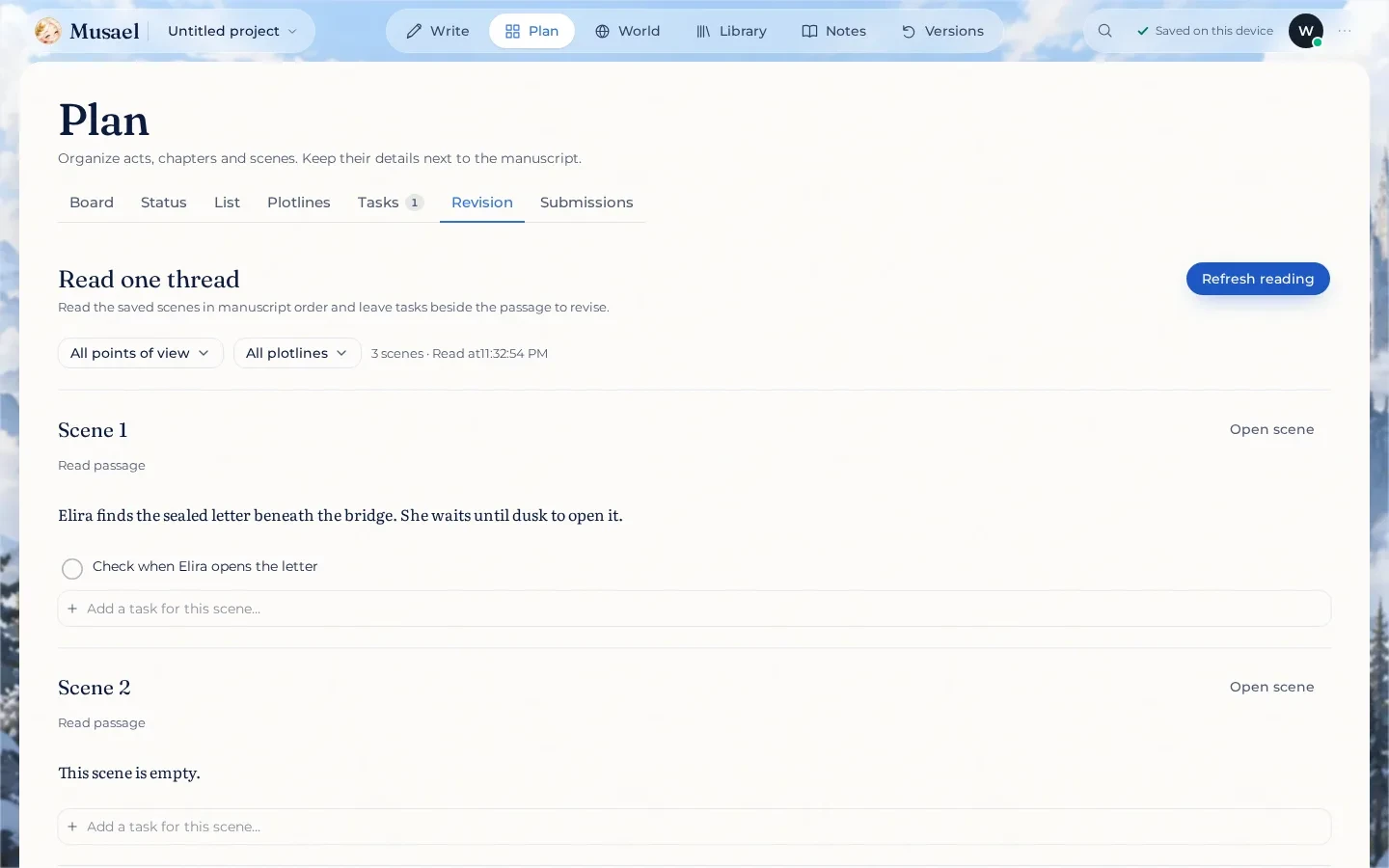
This screenshot uses a test project. Tasks persist beside the scene, and opening the scene returns to the manuscript. Refresh reading after editing; the captured passages describe the saved draft at the time they were read.
For continuity, compare explicit World information and source status. If a character uses a secret, record when it was acquired and used in story time. These checks do not find every plot hole or replace the editorial pass. A scene can satisfy recorded timing and still fail to persuade the reader.
Ask readers for evidence you can act on
Instead of “Did you like it?”, ask a reader where they first understood Elira's goal, which clue felt convincing and where her change of attitude felt abrupt. A comment tied to a passage is easier to evaluate than a global instruction to make the book more exciting.
Musael separates project editing from reader links. Give a reader the scope they need; do not grant co-author access merely to collect feedback. Keep a version before incorporating a large round of notes and decide which suggestions serve your intended story.
Finish the pass with an export and a reading of the changed sequence. The objective is a manuscript you can hand to the next reader, editor or publishing stage, not an endless accumulation of plans and review notes.
Frequently asked questions
How long does it take to write a book?
It depends on length and schedule. At 500 words four times a week, an 80,000 word draft takes about 40 weeks, and revision takes additional time on top. Longer sessions finish sooner, but the useful number is the pace you can repeat.
Should I outline before I start?
You do not have to, but some structure helps. A one-paragraph summary and a few turning points are enough for many writers. If outlines kill your interest, draft first and outline from what you wrote.
How do I keep going when I lose interest in the middle?
Check whether the problem is the book or the schedule. If the story has stopped asking a question, raise the stakes or add opposition. If you are tired, shorten sessions rather than stopping. Park problems in a list and keep drafting.
How many words should a first book be?
It depends on the genre and the publisher. Look at recent published books in your genre and aim near their length. A tighter draft is easier to revise than an overlong one.
Do I need a writing course or a degree?
No. Some writers benefit from workshops, but the core of writing a book is finishing drafts and revising them. Reading widely in your genre and getting feedback from readers teaches a great deal.
Where Musael fits
Musael is a web workspace for these stages. Its plan board shows acts, chapters and scenes on a board or a list, and the plan and the manuscript are the same structure, so moving a scene on the board moves it in the draft. It also keeps a codex of characters and places. Its managed AI review is separate from approving edits. Deterministic scene reading and explicit World checks work without a model request.
Sources
- Randy Ingermanson, "The Snowflake Method For Designing A Novel", Advanced Fiction Writing: advancedfictionwriting.com