
You have written a scene in which the characters talk, the setting is clear, and the plot moves forward. Yet when you reread it, nothing seems to catch. You could cut the scene, but the next chapter needs what happens here.
To fix a flat scene, give the reader an immediate desire to follow, put meaningful pressure on the attempt, and let the scene leave something different. That difference can be small. A character who finally asks for help may create more movement than a character who survives another explosion.
Before polishing every sentence, ask three questions: what does someone want here, what makes that difficult, and what changes because they try? The goal, pressure, and turn checklist below is a revision tool, not a rule for how every scene must work.
Diagnose the scene before rewriting it
Read the scene once without editing. At its end, write down what you were waiting to find out. If you can only name an event from the next chapter, this scene may be postponing the interesting question.
Then choose the closest symptom. Repairing the wrong problem can make a scene longer while leaving it just as flat.
| What you notice | What to check | A possible first repair |
|---|---|---|
| A conversation delivers information, then stops | Does anyone need the information for a present decision? | Make the answer affect an immediate choice. |
| The character gets everything by asking | Is the request costly or difficult for anyone involved? | Give the other person a credible boundary or competing need. |
| A busy scene feels emotionally empty | Do the actions change a relationship, expectation, or option? | Choose one consequence the viewpoint character cannot ignore. |
| Several paragraphs repeat the same feeling | Does each thought add evidence or change the response? | Keep the thought that leads to an action; compress the rest. |
| The scene begins twice | Where does the meaningful attempt actually start? | Enter closer to the request, discovery, or hesitation that matters. |
| The ending explains what the reader already understands | Where does the change first become visible? | Try ending on that action or image. |
Scroll horizontally to see all columns. Arrow keys work when the table is focused.
These are editorial possibilities, not diagnoses a table can settle for you. A deliberately uneventful scene can work. An action scene can fail. Read each in the context of the scenes around it.
1. Give the scene a goal you can see
A character's novel-length desire is often too broad to carry a particular scene.
“June wants independence” tells you about the story. “June wants to borrow her sister's van without admitting she has signed a lease” gives you something to write now.
Try completing this sentence:
In this scene, [character] tries to [specific action] so that [immediate reason].
The action might be getting a signature, keeping a guest from leaving, finding a missing letter, or making someone laugh. It need not be heroic. It should help you recognize an attempt and its result.
If your answer is “learn about the kingdom,” ask what brings the character into that information. Are they challenging a tax, hiding their accent, or choosing which road to take? Exposition becomes easier to shape when someone needs part of it for a decision.
For a scene about grief, the attempt might be smaller: get through breakfast without accepting condolences, ask someone to stay, or finally open an envelope. The goal identifies what matters to this person now; it does not require a chase or an argument.
Do not force a goal onto every paragraph. Find the desire that gives this scene its direction. If the desire itself is unclear, work through the questions in our character development guide before adding obstacles.
2. Put pressure on the attempt
Pressure is whatever makes the easy version of the scene unavailable.
It can come from another person's conflicting goal, limited time, embarrassment, a physical constraint, or two desires the character cannot satisfy together. The useful question is:
Why can't the character simply ask, receive, and leave?
Choose pressure that belongs to the situation. If a conversation feels weak, a sudden storm may make it louder without making it matter more.
For June, the van is available. The problem is that borrowing it will expose the move she has been hiding. Her sister does not need to become cruel or obstructive. She can simply refuse to carry June's secret.
Now June must choose between convenience and concealment. Both sides of that choice come from the scene's existing relationships.
Check the other person's position as carefully as the protagonist's. “Mara wants to stop June” is less useful than “Mara will lend the van, but will not lie to their father tomorrow.” The second version gives Mara a reason to respond and June a specific problem to solve.
Pressure can also come from kindness. Someone offering help may force a proud character to admit what they need. The person creating difficulty does not have to be an antagonist.
3. Find the turn
A scene's turn is a meaningful change between its beginning and end. A request is denied. A suspicion becomes a fact. An alliance becomes a debt. Someone decides to act after trying to avoid the decision.
Write two short statements:
- At the beginning, the character believes, wants, or can do ______.
- At the end, that has changed to ______ because ______.
The “because” matters. If the change arrives independently of anything the character attempts, the scene may feel like a delivery system for news. If news must arrive, make room for a consequential response: whom the character tells, what they conceal, or what they decide to do next.
Not every turn is a reversal, and not every scene needs a cliffhanger. Sometimes the movement is from guardedness to trust. Sometimes an apparent success creates a new obligation. A reflective scene may change what the character understands about an event that has already happened.
Look for evidence of that change in the prose. “She realized she had to be honest” names a conclusion. Putting the phone down and walking toward the person she has avoided lets the reader see the decision become an action.
A worked example: the same errand, a different scene
The following passages are original fictional examples. June wants to borrow her sister Mara's van to move into a new apartment. Their father does not know she is leaving.
Before: the errand goes smoothly
June found Mara in the kitchen and asked if she could borrow the van that evening.
“Moving some things?” Mara asked.
“Just a few boxes.”
Mara took the keys from her pocket and put them on the table. She said the tank was almost empty, so June would need to stop for petrol.
June thanked her and picked up the keys. She was relieved that Mara had not asked any more questions. She went upstairs to finish packing before the storage place closed.
This version is clear. It gives June transport and shows her secrecy. It may be exactly enough if the errand deserves only a brief transition. If it is meant to carry a full dramatic scene, however, June's desire encounters almost no resistance.
After: success has a cost
“Can I have the van until six?” June asked.
Mara slid the keys across the kitchen table, then rested two fingers on them.
“Does Dad know?”
“Know what?”
“Your room looks like a charity shop after closing.”
June pulled out the opposite chair. She had left the kettle on upstairs. No, she had packed the kettle. She had left nothing she would need tomorrow.
“I'll tell him when I'm settled.”
“He asked me to get your cereal.”
“He can eat cereal.”
Mara took her fingers off the keys but did not move her hand away. “You can have the van. I'm not having the conversation for you.”
From the sitting room came the low sound of their father's radio. June could wait until he went to bed, leave the boxes by the door, send a message from the new flat. Each version required Mara to answer the kitchen questions in the morning.
June put her phone face down on the table.
“Will you stay here?”
Mara nodded.
June walked to the sitting-room door. The weather forecast ended. In the brief silence before the next voice, she knocked.
What changed in the revision?
The revised scene keeps the practical objective: June needs the van. It adds pressure through Mara's boundary, rather than inventing an unrelated emergency.
The cereal makes the hidden move concrete. Their father expects June to remain part of tomorrow morning. June's evasive reply shows her defensiveness without naming the emotion. The kettle gives her a brief, practical recognition that she has already dismantled her place in the household.
Most importantly, June gets access to the keys but gives up her plan to leave silently. Her final action creates the next scene's problem. We do not need to hear the entire conversation here.
| Element | Before | After |
|---|---|---|
| Goal | Borrow the van | Borrow the van while keeping the move secret |
| Pressure | Almost none | Mara refuses to conceal the move for her |
| Attempt | Ask and collect the keys | Evade the question, justify the delay, then ask for support |
| Turn | June has transport | June has transport and chooses to tell their father |
| Exit | An explanation of relief | A knock that makes the decision visible |
Scroll horizontally to see all columns. Arrow keys work when the table is focused.
The revision takes more space and attention than the original. That is a cost, not proof of improvement in every novel. If June's departure is incidental to the story, expanding it could distort the pacing. Sometimes the better repair is a short transition.
A reusable scene revision worksheet
Copy these prompts above a troublesome scene or into a note beside it. Answer in plain language before changing the prose.
- Purpose: What would the reader lose if this scene disappeared?
- Goal: What does the viewpoint character try to obtain, prevent, discover, or express here?
- Pressure: What makes the easiest approach unavailable or costly?
- Attempt: What does the character actually do, beyond thinking about the problem?
- Adjustment: How does a response or discovery change their approach?
- Turn: What is different by the end, and what caused that change?
- Evidence: Which line, gesture, object, or action lets the reader notice it?
- Exit: Can the scene end once that change lands?
For the revised example, the short answer is: June needs the van; Mara will not cover for her; June first evades, then asks Mara to stay while she tells their father; the knock shows she has chosen disclosure.
If an answer takes a page, shorten it until it identifies one choice you can revise. “Improve June's character arc” is hard to act on. “Let June ask Mara to stay before she knocks” gives you a passage to write.
Revise the smallest useful section
Save a recoverable version of the draft, then pick one repair from the worksheet. You may need a different response from another character, one consequential gesture, or an earlier ending. Rewriting the whole scene is not automatically the best repair.
Work in this order:
- Repair the movement. Change the attempt, response, or turn before polishing the sentences that describe it.
- Read the scene aloud. Mark explanations that repeat what an action or line of dialogue already shows. Remove or shorten them when the meaning remains clear.
- Read the neighboring transitions. Does the revised opening follow the previous scene? Does the next scene respond to the new outcome?
- Check carried details. A changed promise, object handover, or revealed secret may affect a later scene. Record it where you keep the story's facts.
- Ask for a specific reader response. “What were you waiting to find out?” and “Where did June's decision become clear?” are easier to use than “Was it good?”
This last check separates two questions. A scene can be dramatically effective and contain a factual contradiction; it can also be perfectly consistent and feel lifeless. Our guide to reviewing manuscript continuity covers recorded facts and evidence. The checklist here addresses dramatic movement.
When to leave a quiet scene quiet
This checklist can become a problem if it makes every conversation a contest. Readers also need room for tenderness, grief, observation, humor, and recovery.
A quiet scene may earn its place by changing what a detail means, allowing an emotion to register, or establishing a rhythm that later events will disrupt. Ask whether its stillness is doing deliberate work. Do not confuse low intensity with low value.
For example, a character watering a dead partner's plants may not encounter an obstacle. The scene could matter because they finally water their own neglected plant too. The emotional movement lies in the detail, and adding an argument might obscure it.
Keep the scene when its attention, atmosphere, or shift earns the space. Compress it when it only transports the reader between more consequential moments. Cut or merge it when another scene already performs the same work. Read our story structure guide if you need to judge that work across the whole book.
Keep the repair beside your draft in Musael
In Musael, open Plan and use its Revision view to read the saved scenes you are assessing. Add a specific scene task, such as “Mara lends the van but refuses to lie,” then return to the manuscript to make the change. Refresh the reading after editing so you assess the saved revision.
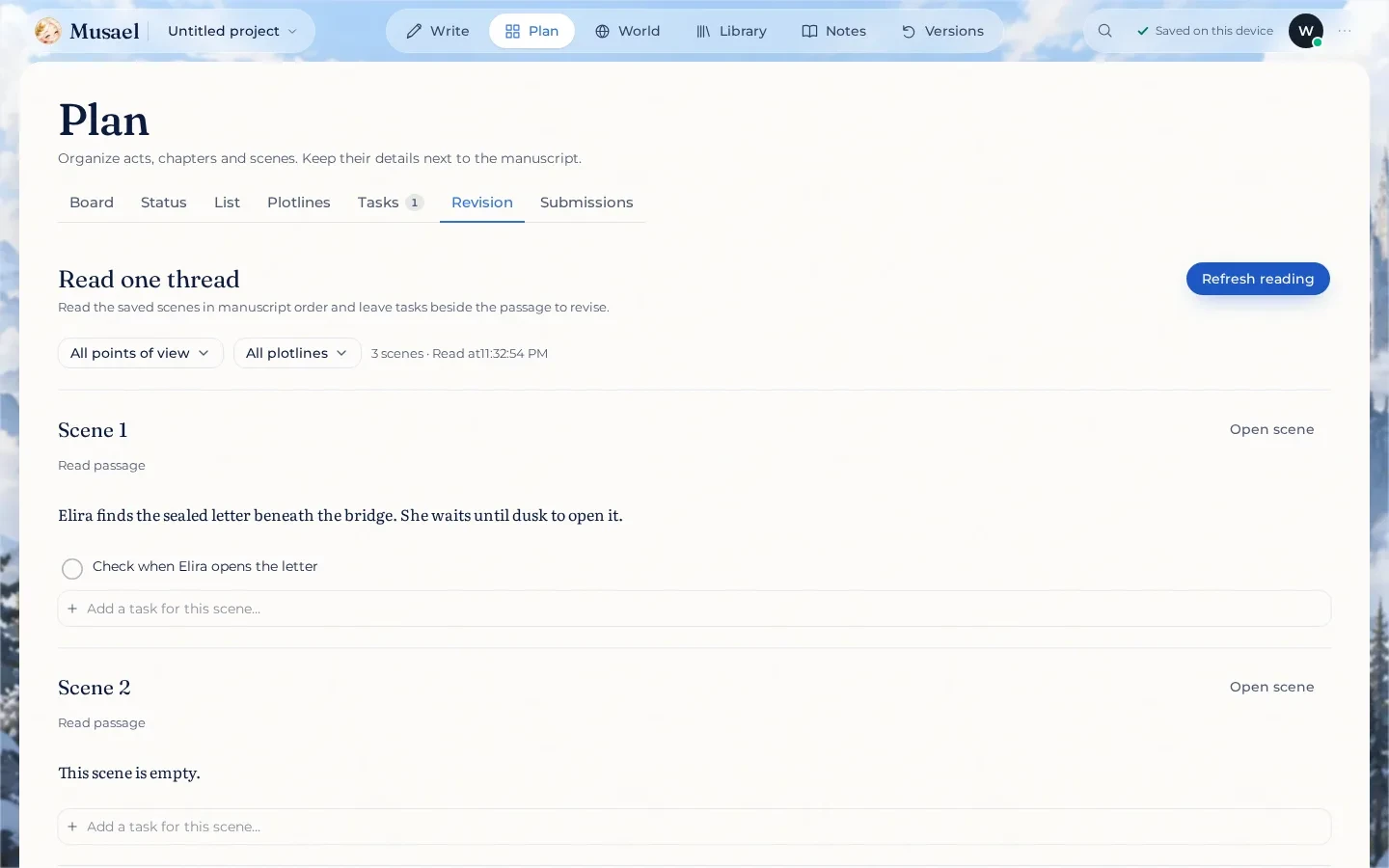
This screenshot shows a test project, not a customer's manuscript. The task and scene reading are existing Musael features; the worksheet above is an editorial method you can apply yourself.
Keep AI feedback as another perspective when you choose to request it. Check suggestions against the scene's purpose, voice, and relationships. A model response does not establish that the scene is weak or that its rewrite belongs in your book. Review proposed changes before approving them.
For a larger revision, start with the passes in how to write a book. For this scene, leave one actionable task, make one repair, and reread its effect. Open Musael when you are ready to work beside your manuscript.
Frequently asked questions
What makes a scene feel flat?
A scene can feel flat when the reader has no immediate desire or question to follow, the attempt meets no meaningful pressure, or the ending leaves everything essentially as it began. Repeated explanation and weak openings or endings can also contribute. Context matters: a quiet scene may be valuable without overt conflict.
Does every scene need conflict?
No. Reflection, recovery, tenderness, and observation can carry a scene. Check what the attention changes or allows the reader to feel. Pressure is useful when an attempt needs shaping, but inventing an argument for every scene can damage the book's rhythm.
How can I fix a dialogue scene without adding action?
Give each speaker a credible reason for their responses. One may want a favor; the other may agree only within a boundary. Let an answer change what can be asked next. A pause, a withheld object, or a precise practical detail can show that movement without a physical confrontation.
Should I rewrite a flat scene or cut it?
Ask what the reader would lose without it. Revise when the scene carries a necessary choice, discovery, or emotional shift that has not landed. Compress when it mainly supplies a transition. Consider cutting or merging when another scene already does the same work.
Is goal, pressure, and turn a mandatory scene formula?
No. It is a diagnostic lens for finding an attempt and its consequence. You can use it without arranging every scene into identical beats. If it hides the value of a deliberately quiet passage, judge that passage by its actual purpose instead.
Can Musael automatically tell me whether a scene is boring?
There is no objective boredom test. Musael provides scene reading, revision tasks, and optional AI feedback to support your assessment. Its continuity checks examine recorded information and evidence; they do not prove that a scene is dramatically effective. Your reading and your readers' responses still matter.