TL;DR
Story structure is the arrangement of events that gives a story momentum. Three acts, the hero's journey, fifteen beats, seven-point and kishotenketsu describe overlapping needs in different words: a want, rising pressure, a turn and a resolution. Pick the model that fits your genre, use it to find weak spots, and change it where the story demands.
Story structure is how a narrative is arranged: which events come in which order, what each one changes, and when the reader learns what. It is a set of patterns that readers have learned to expect, and writers use them to check whether a story builds, turns and resolves. A model is a tool for seeing your book, and nothing obliges you to fill it in.
What structure does
Every structure answers the same practical questions:
- Why should the reader keep reading? The story establishes a want or a question early.
- Why does it get harder? Each attempt costs more or reveals a bigger problem.
- When does the story turn? Something changes what the protagonist or reader understands.
- How does it end? The question is answered, at a cost.
A model gives you a template for those answers, shaped by what many stories have done before.
The main models
| Model | Shape | Best for | Template |
|---|---|---|---|
| Three acts | Setup, confrontation, resolution. | Any genre; simple first drafts. | Three acts |
| The hero's journey | Twelve stages in departure, initiation and return. | Fantasy, adventure, quests. | The hero's journey |
| Fifteen-beat outline | Fifteen turning points across three acts. | Tight, commercial plots. | Fifteen-beat outline |
| Seven-point structure | Hook, turns, pinches, midpoint, resolution, planned backward. | Writers who know the ending first. | Seven-point structure |
| Kishōtenketsu | Introduction, development, twist, reconciliation. | Literary fiction, short stories, quiet books. | Kishōtenketsu |
Scroll horizontally to see all columns. Arrow keys work when the table is focused.
The templates page also lists mystery and romance shapes, which suit those genres.
Three acts
The three-act model divides a story into a beginning, a middle and an end. Act one introduces the character, their world and the event that disrupts it. Act two is the longest: the character pursues the goal, meets resistance and reaches a midpoint reversal, then a low point. Act three is the climax and aftermath. Gustav Freytag's Die Technik des Dramas analyzes classical drama as a rise to a climax followed by a fall, a shape usually drawn as Freytag's pyramid.
Its strength is simplicity. Its weakness is that act two is large and loosely specified, which is where many drafts sag. If you use three acts, add your own turning points inside the middle.
The hero's journey
Joseph Campbell described a pattern across myths in The Hero with a Thousand Faces, and Christopher Vogler adapted it for storytellers into a twelve-stage version. The hero leaves an ordinary world, crosses a threshold, faces trials, endures an ordeal, takes a reward and returns changed. It maps well onto quests, and it asks the writer to think about transformation, not only events. It fits less well where the protagonist does not leave home or where the ending is not a return.
Fifteen beats
Blake Snyder's Save the Cat gives writers a fifteen-beat sheet that runs from an opening image to a final image. Screenwriters used it first, and the Save the Cat site now presents it for novels too. It names the moments a story usually passes through: a catalyst, a break into two, a midpoint, an all-is-lost moment, a finale. The advantage is precision, because you know roughly where the story should have turned. The risk is writing to a checklist, so look for the moments in your own story instead of forcing them.
Seven-point structure
Dan Wells's seven-point structure has seven parts: hook, first plot turn, first pinch, midpoint, second pinch, second plot turn and resolution. You plan backward, starting with the resolution and choosing a hook that is its opposite. It suits writers who know their ending, because the whole arc follows from one destination.
Kishōtenketsu
Kishōtenketsu is a four-part structure from East Asian narrative traditions. Its parts are ki (introduction), shō (development), ten (twist) and ketsu (reconciliation). It does not rely on conflict between a protagonist and an antagonist. Tension comes from an unexpected turn that changes how the earlier parts read. It is useful for short stories, literary fiction and quiet, character-led books, and for anyone who finds conflict-driven models restrictive.
What the models share
Set side by side, the models line up in broad terms:
| Need | Three acts | The hero's journey | Seven-point | Kishōtenketsu |
|---|---|---|---|---|
| Establish normal | The ordinary world | The ordinary world | Hook | Ki |
| Disrupt it | The inciting incident | The call to adventure | Plot turn 1 | Not required |
| Raise the pressure | Rising stakes | Tests, allies and enemies | Pinch 1 and pinch 2 | Shō |
| Turn | The midpoint | The ordeal | Midpoint | Ten |
| Resolve | The climax and the new normal | Return with the elixir | Plot turn 2 and resolution | Ketsu |
Scroll horizontally to see all columns. Arrow keys work when the table is focused.
They are not identical, but they overlap enough that the choice is mostly about vocabulary and emphasis. Choose by which words help you see your own book.
How to choose a structure
- Look at your genre. A mystery needs clues and a fair reveal. A romance needs a reason the couple cannot simply be together. A quiet literary story may suit kishōtenketsu.
- Look at what you know. If you know the ending, seven-point works well. If you know only the opening situation, three acts leaves room.
- Look at how you like to work. More beats means more guidance and less space. Fewer means more freedom and more risk of a sagging middle.
- Try one and see what resists. Where the model does not fit, the story is telling you something. Either the book has an unusual shape you can keep, or a part is missing.
Use structure to diagnose, not to pre-decide
Used as a mold, structure produces predictable books. Used as a diagnostic, it helps you spot problems in a draft you already have. Lay your scenes next to a model and ask:
- Is there a clear point where the protagonist commits?
- Is there a reversal in the middle that changes the question?
- Does the low point cost something the reader cares about?
- Is the climax won by something the character learned?
- Do scenes in the second act escalate, or repeat?
If the answer is no, you have found a place to work, not a rule you broke. To turn a structure into a working plan, see how to outline a novel. For the whole path from idea to finished draft, see how to write a book.
Pacing inside the shape
Structure also governs speed. Early chapters can be short and quick to establish the want. The middle can slow for a reversal or a quiet scene that lets consequences land, then speed up toward the crisis. If every chapter has the same length and tension, readers feel the sameness even when the plot keeps moving. Lay out your chapters by word count next to the model and look for long stretches with no turn.
Structure at three scales
A story has structure at several levels. The whole book has acts. A chapter or sequence has its own small arc. A scene has a want, an obstacle and a turn. A scene that does not turn anything usually belongs somewhere else or nowhere.
Subplots add their own shape. A subplot with a beginning, middle and end that meets the main plot at key points enriches a book. One that never touches the main plot tends to feel like a different story.
Structure and order of telling
The order of events in the story and the order in which the reader learns them can differ. Flashbacks, parallel timelines and delayed reveals rearrange what the reader knows without changing what happened. When you use them, keep both timelines clear. A table with columns for story time and first shown is a practical way to do it.
Apply a structure to choices, not labels
Consider an invented harbor mystery with a protagonist who wants to find her missing brother. A three-act structure can describe how her choices change the situation:
| Stage | Scene event | Why it changes the story |
|---|---|---|
| Opening | She finds a sealed letter | The missing person becomes an actionable mystery |
| Commitment | She breaks an archive rule to investigate | Returning to ordinary life now has a cost |
| Midpoint | The seal was used by someone else | Her initial explanation becomes insufficient |
| Crisis | Her concealment causes an ally to withdraw | The old strategy cannot deliver the goal |
| Climax | She tells the truth and acts with the ally | A new choice addresses both the mystery and her failure of trust |
Scroll horizontally to see all columns. Arrow keys work when the table is focused.
The labels are descriptions. They do not make the scene effective. If the midpoint only adds information and changes no later behavior, inspect whether it is actually doing the work your outline assigns to it.
A template can help create this initial arrangement. In Musael, inspect the resulting acts, chapters and scenes, rename their working titles and add scene-specific intentions. The template is scaffolding; your manuscript must earn each turning point.
Revise two structures at once
The investigation and the trust arc can have different rhythms. A clue may advance the external plot while worsening the relationship. Mark both plotlines and write a separate note for each in the scenes they share.
Use Plan → Revision to read the saved passages for one thread, then combine its plotline with a POV filter when needed. A missing relationship beat becomes a scene task, not a reason to move every chapter to a prescribed percentage.
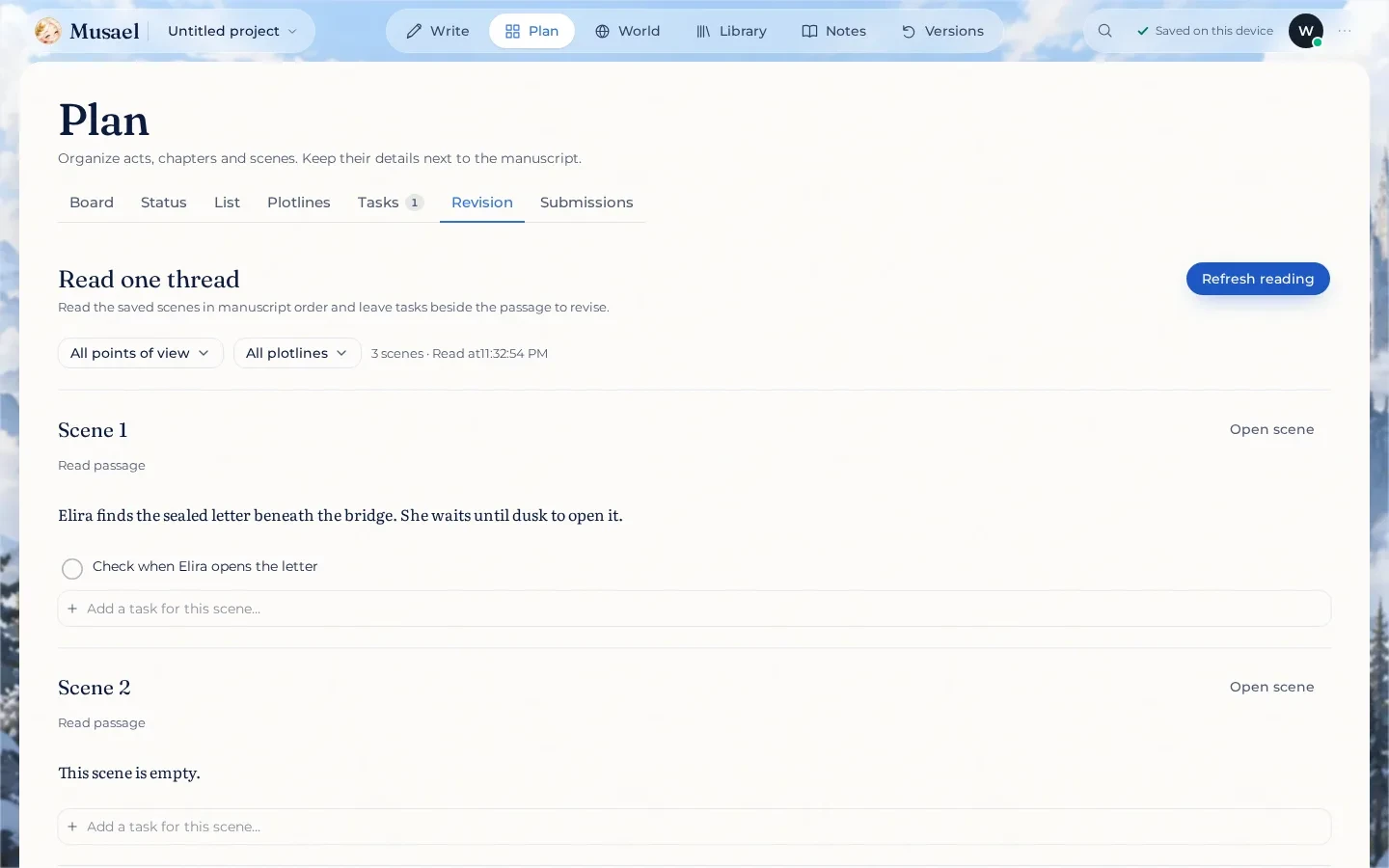
This test-project screenshot demonstrates the connection between passage and task. It does not score the structure or certify that a turning point is convincing.
Rearrange revelation while preserving chronology
Move the scene explaining the seal's origin before the protagonist finds the letter. You have changed the reader's information: suspense may replace mystery. You have not necessarily changed when the seal was used or when the protagonist learned its origin.
Keep the chronological event in World separate from reading order. For a knowledge-dependent reveal, record acquisition and use explicitly. Unknown timing remains uncertain; a chapter number is not a substitute for story time.
Save a version before the restructure, reread the affected plotlines and refresh the saved reading after prose changes. Check transitions and source passages as well as the outline. Structure becomes useful when it helps you explain a revision, not when it gives the draft impressive-looking labels.
Frequently asked questions
What is story structure?
It is the arrangement of events and revelations in a story so that tension builds and resolves. Common models, such as three acts, divide a story into parts with specific functions: setup, escalation, turn and resolution.
What is the best story structure for a novel?
There is no single best one. Three acts is the simplest and fits most genres. The hero's journey suits quests, seven-point suits writers who know the ending, and kishōtenketsu suits quiet stories. Choose the one that fits your book.
Do I have to follow a structure?
No. Many published books depart from the common models. But readers expect certain things, such as a reason to keep reading and a payoff, so it helps to know the models before you break them.
Is the three-act structure outdated?
It is old, but it describes needs that remain: a want, escalation, a turn and a resolution. Other models rename these needs. The three-act model is a starting point you can refine.
How is structure different from plot?
Plot is the specific events of your story. Structure is the pattern that arranges those events. Two different plots can share the same structure, which is why a structure works as a diagnostic across books.
Where Musael helps
Musael's plan board shows acts, chapters and scenes as a board or a list. Each structure above is available as a template that opens as acts, chapters and scenes, with a note on every scene about what usually happens there. You can rename, move or delete any of it.
Sources
- Gustav Freytag, Die Technik des Dramas, Project Gutenberg: gutenberg.org/ebooks/50616
- Save the Cat!, "Beat Sheets": savethecat.com/beat-sheets