TL;DR
An outline is a working plan for your plot. Start with a one-sentence premise, pick a structure, mark the turning points, then list scenes that each have a want, an obstacle and a change. Choose the depth that suits you, from one page to a card per scene, and revise it as the draft teaches you what the story is.
An outline for a novel is a list of what happens, in order, with enough detail that you know where each scene is going. Some writers draft from a page of notes. Others plan every scene. Neither is wrong. Build the outline in stages and stop at the depth that helps you. For the whole path from idea to finished book, see how to write a book.
Why outline at all
An outline answers three questions before you spend months drafting: does the story have enough to sustain a book, where does it turn, and does it end somewhere. It also makes the middle less frightening, because you have already decided what the next scene needs to do.
Outlines have costs. A rigid outline can drain the discovery that keeps drafting interesting, and it can lock in an idea that stops working by chapter ten. Treat the outline as a hypothesis. You test it by writing, and you change it when the draft shows a better path.
Step 1: Write the premise in one sentence
A premise states the protagonist, the goal and the obstacle. Aim for one sentence you could say to a friend.
A ferry clerk in a guild-run harbor city must find who sealed the letter that got her brother arrested before the guild finds her.
If you cannot write it, you may not have a protagonist's want yet, or the conflict is vague. Rewrite until each part is specific. Randy Ingermanson's Snowflake Method begins with this same one-sentence summary and expands it in stages. He advises keeping it short and leaving out character names. The expansion is a good pattern even if you do not use the full method.
Step 2: Choose a structure to lean on
A structure gives you the turning points so you do not invent every one from nothing. Story structure explained compares the common models. The simplest is three acts:
| Part | What it does | Your note |
|---|---|---|
| Act I | Introduce the protagonist, the want and the disruption. | Mara finds the sealed letter. |
| Act II, first half | She pursues the goal and meets resistance. | She works through the guild's records. |
| Midpoint | A reversal changes the question. | The seal is her brother's own. |
| Act II, second half | Pressure rises and the flaw costs her. | A friend is dismissed because of her. |
| Act III | The final test and its consequence. | She exposes the guild and loses her post. |
Scroll horizontally to see all columns. Arrow keys work when the table is focused.
If a ready-made shape would help, the three acts, seven-point and fifteen-beat templates in Musael open as acts, chapters and scenes you can edit.
Step 3: Mark the turning points
Turning points are the events after which things cannot go back. Find these six and write each in a sentence:
- The disruption. What ends the protagonist's normal life?
- The commitment. When do they choose to pursue the goal?
- The midpoint. What reversal changes what they think they are doing?
- The low point. What is the worst moment, and what does it cost?
- The climax. What final choice settles the question?
- The new normal. What is different afterward?
If you know the ending but not the middle, write the six in reverse. Seven-point structure, from Dan Wells, uses the same backward planning.
Step 4: Break turning points into scenes
Between the turning points are the scenes that get you there. List them as short lines. A useful scene has a person who wants something, an obstacle, and a change by the end. Use a card for each:
| Field | Notes |
|---|---|
| Scene title | A phrase you will recognize. |
| Point of view | Whose head are we in? |
| Where and when | Place and time, or relative time. |
| Want | What the point-of-view character is trying to do. |
| Obstacle | Who or what is in the way. |
| Turn | What is different at the end. |
| Reveals | What the reader learns. |
| Open questions | What you have not decided. |
Scroll horizontally to see all columns. Arrow keys work when the table is focused.
If you cannot fill in the turn, the scene may not need to exist, or it may be two scenes. If two scenes in a row have the same turn, merge or cut one.
Link scenes with cause and effect
Read your list and join consecutive scenes with "therefore" or "but", not "and then". "Mara forces the archive door, and then she meets a clerk" is a sequence. "Mara forces the archive door, therefore an alarm sounds, but the clerk who finds her recognizes her brother's name" is a plot. Every "and then" is a place to look for a missing cause.
Choose a depth that suits you
You can start shallow and add detail where you need it.
| Depth | What it contains | Suits |
|---|---|---|
| Skeleton | Premise plus six turning points, about one page. | Writers who like to discover. |
| Chapter list | One to three lines per chapter. | Many novelists. |
| Scene cards | A card per scene with the fields above. | Complex plots, mysteries, several points of view. |
Scroll horizontally to see all columns. Arrow keys work when the table is focused.
Detail should serve the draft. If you have lost interest in a scene by the time you outline it in full, the outline may be killing the story. Go shallower and draft.
Outline by thread when the plot is complex
Books with subplots, several points of view or a mystery benefit from tracking threads separately. List each thread with its beginning, middle and end, then interleave the scenes. A mystery needs a clue schedule: what the reader learns when, and which false lead covers it. A romance needs the barrier and the moments each person moves toward or away. The mystery and romance templates show those shapes.
Mark what the reader knows and what the character knows. A reveal that works for the reader but not the character is dramatic irony; the reverse is a mystery. Two columns make this visible.
Keep the outline alive
An outline is wrong the moment you start writing, because you will learn things. That is the point of drafting. Keep it useful:
- Update it after each act, not after each scene. Compare what you wrote to what you planned and note what changed and why.
- Keep a record of decisions. If you change the midpoint, write the old idea in a notes file. You may want it back.
- Mark scenes as planned, drafted or revised. It shows how much of the plan has met the page.
- Re-outline from the draft before you revise. List what the scenes actually contain. Gaps between plan and draft show what to fix.
Save a copy before a major restructure so you can compare and restore.
Test the outline before you draft
Tell the story aloud in five minutes using only your notes. Where you hesitate, skip a step or say "and somehow", there is a gap. Ask one friendly reader to listen and say where they lost interest.
Then check three things. Does the protagonist make choices that cause the major turns, or does the plot happen to them? Does each act end on a decision or a loss the next act has to answer? Is the ending earned by something set up earlier? If any answer is no, fix the outline now, while changing a line costs a minute and not a chapter.
Common outlining mistakes
- Outlining events instead of changes. "They go to the harbor" is an event. "Mara learns the guild forged the stamp" is a change.
- Planning everything before knowing the characters. If the outline stalls, write a scene to learn a character, then return.
- Treating the outline as a promise. You owe the book, not the plan.
- No obstacles. A list of things that go well is a summary, not a plot.
- An empty middle. If the turning points are clear but the middle is a column of question marks, add a midpoint reversal and a pressure that escalates.
A complete small outline you can test
Here is an invented six-scene mystery, deliberately small enough to inspect as a whole. Its central question is who used a missing clerk's seal. A relationship subplot changes whether the protagonist can trust the person helping her investigate.
| Scene | POV and action | Investigation thread | Trust thread |
|---|---|---|---|
| 1. The bridge | Elira finds the letter and refuses help | Establish the seal and the missing clerk | She treats help as a threat |
| 2. The registrar | Elira asks who can read it | Receive an explanation that later proves incomplete | She chooses an official over an ally |
| 3. The locked archive | Elira needs the ally's access | Find evidence that someone else used the seal | She accepts help but withholds the letter's origin |
| 4. The clerk's account | The ally recalls an earlier event | Establish the seal's actual use in story time | Reveal why the ally distrusted the registrar |
| 5. The accusation | Elira's incomplete story causes a dispute | The evidence becomes harder to obtain | Withholding the truth has a visible cost |
| 6. The quay | Elira tells the truth and acts with the ally | Resolve who used the seal and why | Demonstrate trust through a consequential choice |
Scroll horizontally to see all columns. Arrow keys work when the table is focused.
This is not a formula for every novel. It demonstrates how a scene can move two threads while each thread does different work. If removing scene three leaves the ending equally convincing, its role needs reconsideration.
Turn the outline into one Plan
In Musael, create the acts, chapters and scenes, then assign the relevant POVs. Add the investigation and trust plotlines. A scene can participate in both with different notes; do not duplicate the scene just because it serves two purposes.
The outline and manuscript use the same scene records. After drafting, read the saved investigation thread in Plan → Revision. Then read trust separately and compare its notes with the actual behavior.
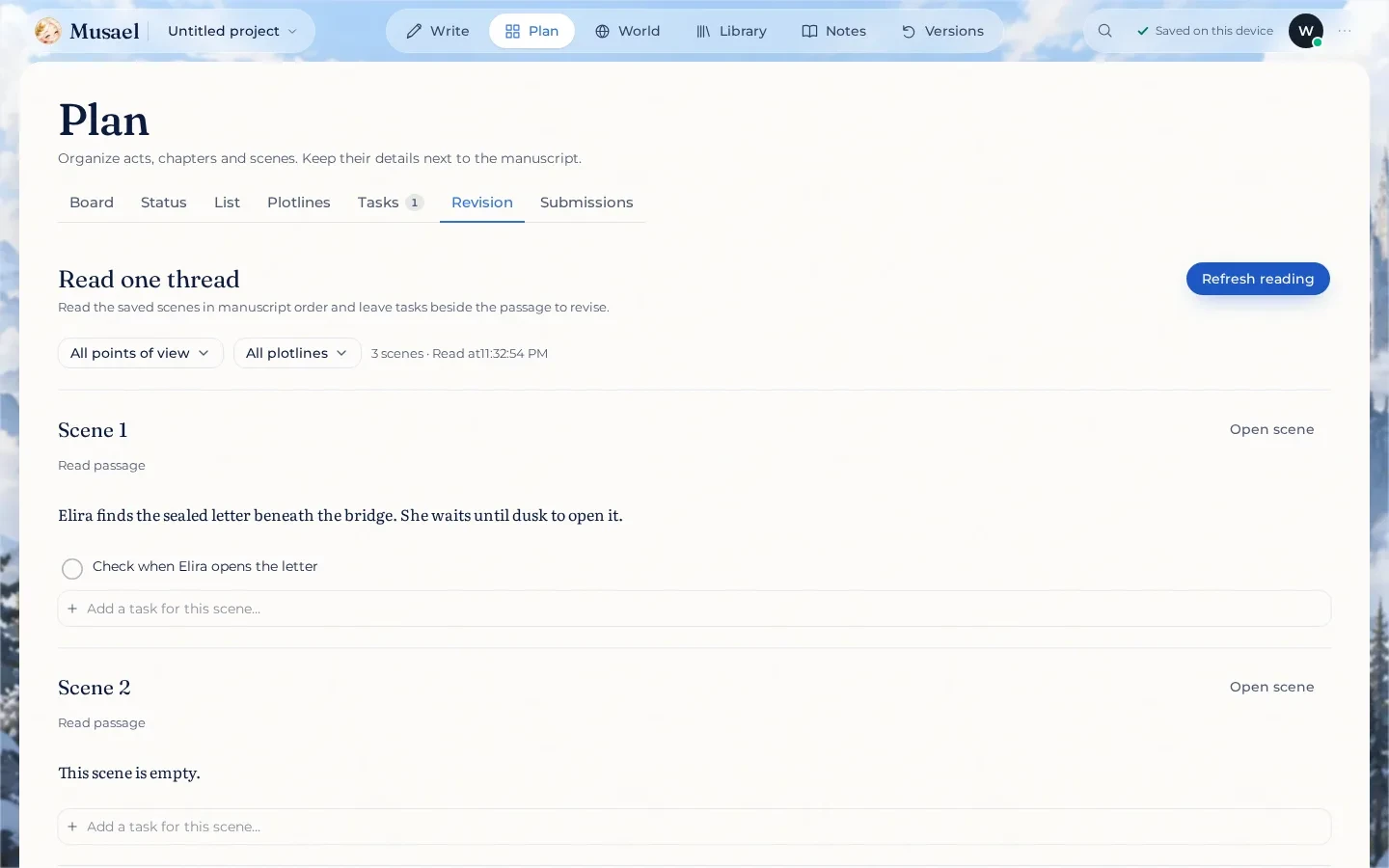
The screenshot uses a test project. The point of this view is the difference between “the outline says it happens” and “the saved passage actually does it.” Leave a concrete scene task when those disagree.
Move a scene without rewriting history
Try moving the clerk's account from scene four to the opening. The historical event it describes has not changed, but the reader now knows it earlier. Ask which later questions lose their suspense and whether Elira knows what the reader knows.
Record story-time information in World separately from manuscript order. If the moved passage reveals a fact to Elira, update the acquisition record deliberately; do not infer it merely from its new chapter number.
Keep a version before a large restructure. After moving scenes, read the affected thread again, check references to “yesterday” or “earlier” and refresh evidence checks. An outline is a working hypothesis about the book, not an excuse to ignore what revision changed.
Frequently asked questions
How detailed should a novel outline be?
Detailed enough that you know what the next scene must do. For many writers that is a chapter list with one to three lines each. Add scene cards only where the plot is complex. If detail makes you lose interest, go shallower.
How do I outline a novel if I am a pantser?
Draft first, then outline what you wrote. A list of what each scene contains shows the shape and the gaps. You can also write a premise and six turning points and discover everything between them.
What is the first step in outlining a novel?
Write a one-sentence premise with a protagonist, a goal and an obstacle. Then choose a structure and mark the main turning points. Scenes come after those.
Should I outline before or after writing the first draft?
Either works. Outlining first gives direction and fewer structural rewrites. Outlining after gives accuracy about what the book actually does. Many writers outline lightly first and in detail after the draft.
How long should a novel outline be?
It varies. A skeleton may be one page. A chapter list may run a few pages. Scene cards for a long novel can number in the dozens. Length is not a measure of quality.
Where Musael helps
On the plan board, acts, chapters and scenes appear as a board or a list. Each scene carries status, point of view and notes, and moving a scene on the plan moves it in the manuscript too, so the outline and the draft stay one structure instead of two documents to reconcile.
Sources
- Randy Ingermanson, "The Snowflake Method For Designing A Novel", Advanced Fiction Writing: advancedfictionwriting.com