TL;DR
Character development has two halves: who the character is when the story opens, and how the plot pressures them to change or refuse to. Give each major character a want, a need they do not see, a flaw that costs them, and a belief the story tests. Show change through choices at rising cost, and keep notes so behavior stays consistent.
Character development has two meanings, and writers often mix them up. The first is building a character: deciding who they are, what they want and how they behave. The second is the character's development within the story: how events change them, or fail to. A reader who says a character "developed well" usually means the second. The two are connected, and the first has to come before the second.
Build the character before you ask them to change
A character who changes needs a starting point. Four elements give you one that is concrete enough to test.
| Element | What it is | Example (imaginary novel) |
|---|---|---|
| Want | What they pursue, consciously. | Mara wants to learn who sealed the letter. |
| Need | What they lack and may not see. | She needs to accept that her brother chose his risk. |
| Flaw | The habit that costs them. | She treats every locked door as an insult and forces it. |
| Belief | The idea behind the flaw. | If she knows everything, nobody can take her family again. |
Scroll horizontally to see all columns. Arrow keys work when the table is focused.
The want drives the plot. The need drives the change. The flaw makes the want harder to reach, and the belief explains why the flaw feels reasonable from the inside. When a character feels flat, one of these is usually missing, most often the belief: they do things but have no reason that makes sense to them.
E. M. Forster, in Aspects of the Novel, divided characters into flat and round. A flat character is built around a single idea and can be summed up in one sentence. A round character is one who can surprise the reader in a convincing way. Forster notes that a complex novel often needs both kinds. Your protagonist and the people closest to them usually need to be round, while a ferry porter who appears twice can be a clear single note.
Show who they are through choices
Description tells readers what a character looks like. Choices tell readers who they are. Put your character in a situation where two things they value conflict, and let them choose. A reader learns more from Mara lying to a friendly guild clerk to protect the friend who helped her than from a paragraph about her honesty.
Useful ways to show character without listing traits:
- What they notice. A thief and a nurse walk into the same room and register different things.
- What they avoid saying. Gaps in dialogue show fear or pride.
- How they treat people with no power over them. A tip, a rebuff, a favor asked.
- What they do with small objects. Habits are cheap and memorable.
- What others say about them when they are absent. Disagreement between characters gives depth.
Voice also develops character. If the same line could come from two characters, one of them is not yet distinct. Read their dialogue aloud and check that vocabulary, rhythm and what they leave out differ.
The shape of change
A character arc is a pattern of change across the story. It does not have to be positive. Four common shapes:
- Positive change. The character overcomes the flaw or replaces the false belief.
- Fall. The character holds the belief until it destroys them.
- Flat arc. The character already holds a true belief and tests it against a world that resists, changing others rather than themselves.
- Disillusionment. The character learns a hard truth and loses an illusion without necessarily getting better.
Choose a shape for each major character and check it against the ending. Mara believes that knowing everything protects her family. A positive arc has her accept uncertainty. A fall has her learn everything and lose the people she was protecting. Both are legitimate; the difference is what the book is about.
Change happens in steps
A character rarely changes in one scene. Plan four or five beats, each a choice under growing cost:
| Step | What happens | What it shows |
|---|---|---|
| 1 | The flaw works. | Mara forces a door and gets a clue. |
| 2 | The flaw works at a price. | The same move gets a friend dismissed. |
| 3 | The flaw fails. | A forced door sets off an alarm. |
| 4 | The character doubts the belief. | She admits to the friend what she was afraid of. |
| 5 | The character acts differently when it counts. | She leaves a door shut and asks. |
Scroll horizontally to see all columns. Arrow keys work when the table is focused.
The last step is the one readers remember, because it is behavior, not a statement. A character who says they have changed has not yet changed.
Pressure is what reveals development
A comfortable character stays the same. Plot gives character development its force by raising the cost of the flaw. Each major scene should push on the belief: either it works and the character grows more certain, or it fails and the character has to decide whether to adjust.
For every major scene, ask what the character wants in it, what they do, and what it costs. If the cost is nothing, the scene probably does not move the character. Story structure explained shows where the pressure points usually sit, such as the midpoint reversal and the low point before the climax.
Secondary characters need development too, but smaller: a wish and a limit are enough. A good secondary character wants something that sometimes conflicts with the protagonist, which creates scenes without villains.
Let other characters reveal development
A change is easiest to see in relation to someone else. Put the protagonist in a second scene with a person from an earlier one and let the difference speak. If Mara once lied to the friendly clerk to get a key, a later scene in which she tells the same clerk the truth and asks for the key shows the arc without a word of commentary. A foil works the same way: a character who shares the protagonist's belief but follows it to the end shows what the protagonist could become.
Relationships also carry stakes. A change that costs the protagonist nothing in their relationships is rarely believable. Decide who gains and who loses when the character changes, and let at least one person resist it, because people close to us often prefer the version of us they already know.
Avoid the common traps
- A list of traits instead of a want. "Brave, sarcastic, loyal" gives actors little to do. "Wants to be left alone but cannot ignore a person in trouble" gives scenes.
- Backstory that does not touch the plot. A tragic past matters when it feeds the belief that drives present choices. Otherwise it is decoration.
- Change by announcement. Realizations in dialogue convince less than a changed choice.
- Surprises nobody can explain. Characters can surprise readers, but the surprise should make sense afterward.
- Everyone talks the same. Differentiate speech, attention and priorities.
- Perfect protagonists. Flaws that cost something make readers care.
Keep characters consistent across a long draft
Over a long draft, small details drift: an age, a scar, a habit, who knows which secret. Keep a short entry per character with the want, need, flaw, belief and the facts that scenes have established, plus what the character knows at each stage. The character profile template gives you the fields to copy, and how to build a story bible covers the wider reference.
A quick check when you revise a character:
- Their want is stated in a sentence and visible in action.
- Their flaw costs them at least twice before the climax.
- Their belief is tested by a scene that could break it.
- Their change is shown by a choice, not a speech.
- Their voice differs from the other main characters.
- What they know matches what they have been told on the page.
Follow one character through three decisions
Consider an invented protagonist, Elira, who believes accepting help makes her weak. Her external goal is to recover a missing letter; her internal change is learning to trust someone without giving up responsibility for her choices.
| Scene | Pressure | Decision on the page | Consequence for the arc |
|---|---|---|---|
| At the bridge | A clerk offers to read the seal | Elira refuses and hides the letter | Her independence protects her, but leaves her with a mistaken conclusion |
| At the archive | She cannot enter alone | She accepts help while withholding a crucial detail | Partial trust works briefly and then creates a new conflict |
| At the quay | Her ally must choose whether to stay | She tells the truth and asks for help | Her action demonstrates a changed approach rather than announcing a new trait |
Scroll horizontally to see all columns. Arrow keys work when the table is focused.
The same profile can support all three scenes. What develops is the relationship between belief, action and cost. A sentence saying “she had learned to trust” cannot replace the final decision.
If the middle scene is missing, the final choice may feel sudden. Add a test of the old belief rather than a paragraph explaining the intended arc. If the protagonist behaves identically in all three scenes, decide whether the story deliberately portrays resistance or whether the revision has not yet reached the behavior.
Review the arc through Musael's saved scenes
Create the character in World, assign Elira as the POV where appropriate and add a plotline for the trust arc. In each participating scene, record a short thread note describing the decision, not a vague mood such as “character growth.”
Then use Plan → Revision with the POV and plotline filters. The passages are read from the saved manuscript, so you can compare the outline's intention with the actual dialogue and action.
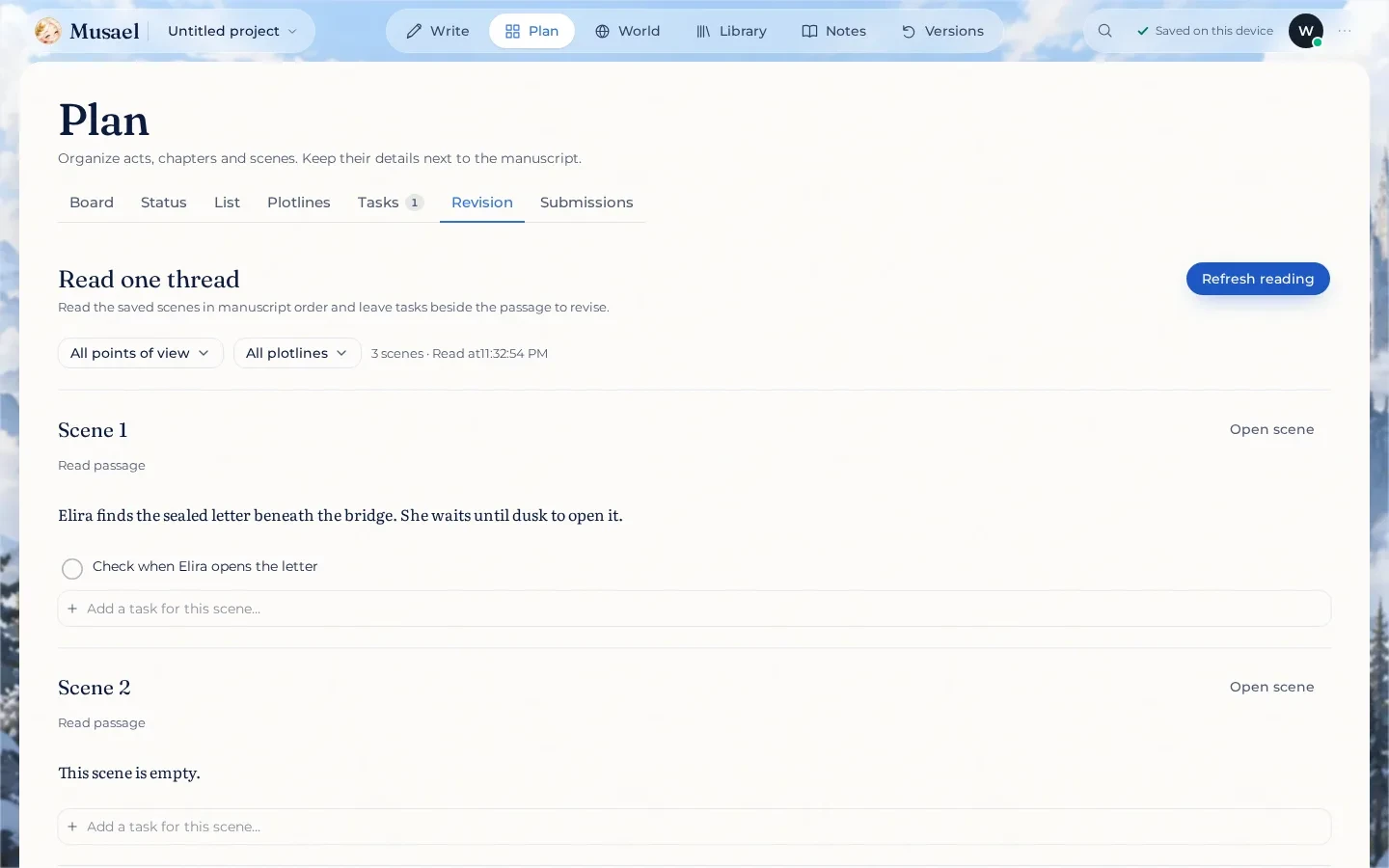
The screenshot uses a test project. A task such as “give Elira a reason to reject the first offer” belongs beside the scene to revise. Open that scene and make the change in the authoritative manuscript; the revision view does not maintain a second editable copy of the arc.
Refresh the reading after editing prose. A previously captured passage is evidence of the draft at capture time, not a promise that later edits are already reflected.
Separate a mistaken belief from a broken character
Elira may believe the registrar is trustworthy while the reader knows otherwise. That does not make her characterization inconsistent. In World, distinguish her belief from a confirmed fact and attach the relevant passage.
If the story depends on when she learns the truth, record acquisition and use against story time. A flashback presented late is not automatically late in her life. The explicit knowledge check can flag a recorded early use, but it cannot decide whether a gesture implies understanding or whether a lie is convincing.
Finish the pass by reading the final choice without your notes. Can a reader see what she risks and why she acts differently? That is the test the profile and revision tools are there to support.
Frequently asked questions
What is character development?
It is how a character is built and how they change across a story. Building means giving them a want, a flaw and a belief. Development means events test that belief and the character changes or refuses to. It is shown through choices.
What is the difference between a character arc and character development?
Character development is the broader process of building and deepening a character. A character arc is the specific path of change a character follows over the story, such as from fear to courage or from trust to disillusionment.
Do all characters need to change?
No. Some protagonists hold a true belief and change the world around them. Secondary characters often stay stable and serve as contrast. What matters is that major characters are tested and that the outcome fits the story's meaning.
How do I show a character changing without telling the reader?
Repeat a similar situation at different points and have the character respond differently. A choice made early under pressure and a different choice made late under similar pressure shows change without an explanation.
How do I make a character likable?
Likable matters less than understandable and interesting. Give them a want readers can follow, show them under pressure, and let them be competent at something or kind to someone. Flaws that cost them make readers care more, not less.
Where Musael helps
Musael keeps your characters in a codex with relations to other characters and places, and names in the manuscript link back to their entry, so you can see where each person appears. The world and characters feature shows how entries connect. Managed AI review can offer suggestions under the current plan; inspect them and approve edits deliberately. POV/subplot reading and explicit World checks do not require a model request.
Sources
- E. M. Forster, Aspects of the Novel, chapter on people (flat and round characters), Project Gutenberg: gutenberg.org/ebooks/70492