Start with the facts you actually use
A story bible keeps track of the people, places, rules and events in your manuscript. Start with the details you need for the next scene; you can fill in the rest as you write.
Use the questions that come up while you draft. Who knows about the missing letter? Which door leads to the courtyard? What happened before the characters arrived? Write short answers, then record where each answer comes from. Keep each entry short enough to find the answer and get back to writing.
Keep facts small enough to check. “The west gate is locked after sunset” is more useful than a page of atmosphere when you need to decide whether a character can leave the city.
Separate facts, beliefs and open questions
Label each entry as a fact, a belief or an open question. A character can be wrong. A narrator can withhold an answer. An idea you have not committed to is still an idea.
| Information | Example | What to record |
|---|---|---|
| Established fact | The west gate closes at sunset. | The scene that establishes the rule. |
| Character belief | Mara thinks the gatekeeper has left. | Who believes it and when. |
| Open question | Does the gatekeeper recognize the seal? | What still needs a decision. |
Scroll horizontally to see all columns. Arrow keys work when the table is focused.
Leave a question open until you have an answer. A plausible guess can easily be mistaken for an established fact when you return to your notes. When a later scene changes a fact, keep enough of its history to understand which version the reader encountered first.
Give each entry a clear name
Use a name you will recognize while drafting. Put alternate spellings, titles and nicknames alongside it. If two characters share a name, add a short distinguishing phrase instead of relying on memory.
A location entry can start with its role in the story, the people connected to it, and the details that constrain a scene. A character entry can start with their goal, relationships, relevant knowledge and a source for each important fact.
Connect every important fact to a source
Link each important fact to the place where you recorded it. The source may be a scene, a planning note or a research document. A planning note records an intention. A scene shows what made it into the manuscript. Keep that distinction visible when you cite them.
- Write
Draft the scene and let the story reveal what matters.
- Record
Capture the fact, the character belief or the open question.
- Connect
Keep a link to the scene or note that supports it.
- Review
Revisit the entry when the manuscript changes.
After each writing session
Repeat these four steps after a writing session or while revising a chapter. Record the details you expect to look up again.
Keep story time separate from reading order
A flashback may show an old event several chapters after it happened. Parallel scenes and delayed revelations can also put events in a different order for the reader.
Try writing down both orders in a table:
| Event | Story time | First shown to the reader |
|---|---|---|
| The letter is delivered. | Before sunrise | Chapter 3, in a recollection |
| Mara finds the broken seal. | That afternoon | Chapter 1 |
| The gatekeeper explains the seal. | The next day | Chapter 4 |
Scroll horizontally to see all columns. Arrow keys work when the table is focused.
The events above are examples. For your own story, record uncertain dates as they stand: “before the storm” can be a useful constraint even when the exact date is undecided.
Make the reference easy to scan
Choose a format that makes the note easy to use. Use headings for questions, lists for checks, and tables when a reader needs to compare the same properties across several items. Keep long research extracts outside the summary so the important facts remain easy to find.
- Names and aliases: one preferred name with its alternatives.
- Relationships: who is connected, and the direction of that connection.
- Time: when the information is true or believed.
- Sources: where the manuscript establishes the information.
- Questions: decisions you have not made yet.
A compact note can be enough:
Fact: the west gate closes at sunset.
Source: the arrival scene.
Known by: Mara and the gatekeeper.
Open question: who holds the spare key?
Review the bible alongside the manuscript
When you move a scene, change a motive or cut a detail, revisit the notes that depend on it. An entry can be accurate when you write it and wrong after the next revision.
Use this checklist after a substantial revision:
- Check that the cited scene still contains the fact.
- Confirm which characters know it at that point.
- Check whether the timeline or location has changed.
- Resolve contradictory notes, or keep the uncertainty explicit.
- Save a recoverable copy before a large structural change.
In Musael, keep these references in the Codex alongside your manuscript. Continuity checks report the rules they can evaluate and point back to their sources. Review each result against the scene and the context you intended. See how a continuity checker reads a manuscript for that distinction.
What if I prefer to discover the story as I write?
Build the reference after the scene. Record only details that have become useful, and leave room for decisions you have not made. The same small loop works for discovery writing and for a detailed outline.
Keep the first version small
Begin with one character, one location and a handful of facts that your next scene depends on. Add structure when it removes repeated work. Keep adding to the bible as you write, so the details are there when you need them.1
A worked example: from a scene to a World record
The following harbor-city story is an invented example. Elira finds a sealed letter beneath a bridge. She believes the seal belongs to her missing brother; later, the registrar tells her that another clerk used it. The bible should preserve what the manuscript establishes without turning Elira's interpretation into a world fact.
Start with four small records:
| Record | What belongs in it | Evidence or uncertainty |
|---|---|---|
| Character: Elira | The person who finds and later opens the letter | Confirmed by the opening scene |
| Object: sealed letter | The object found beneath the bridge | Attach the discovery passage |
| Belief: her brother sealed it | Elira's interpretation at the bridge | The passage establishes her belief, not the seal's true author |
| Open question: who used the seal? | A decision still needed for the mystery | Do not mark it confirmed until the story establishes an answer |
Scroll horizontally to see all columns. Arrow keys work when the table is focused.
In Musael, keep the character and object in World. Add the relevant assertion with the appropriate epistemic kind, then connect the source passage. Confirming a record is an explicit approval; an idea in your notes should not quietly become established canon.
The important part is not filling every available field. It is being able to answer: “What does this record mean, and why do I believe it is established?” If a record cannot answer that, shorten it or leave it as an open question.
Record knowledge in story time
Suppose Elira learns the true seal user at story-time tick 10 and cites that name in a scene at tick 6. Record both acquisition and use against the same timeline. A tick is your project's unit, not a calendar invented by the software.
World → Checks → Revision tools → Character knowledge compares those author-recorded times. It can flag the use as earlier than acquisition. If either time is unknown, or the intervals overlap, the result stays uncertain. A guess should be recorded as a guess rather than treated as knowledge.
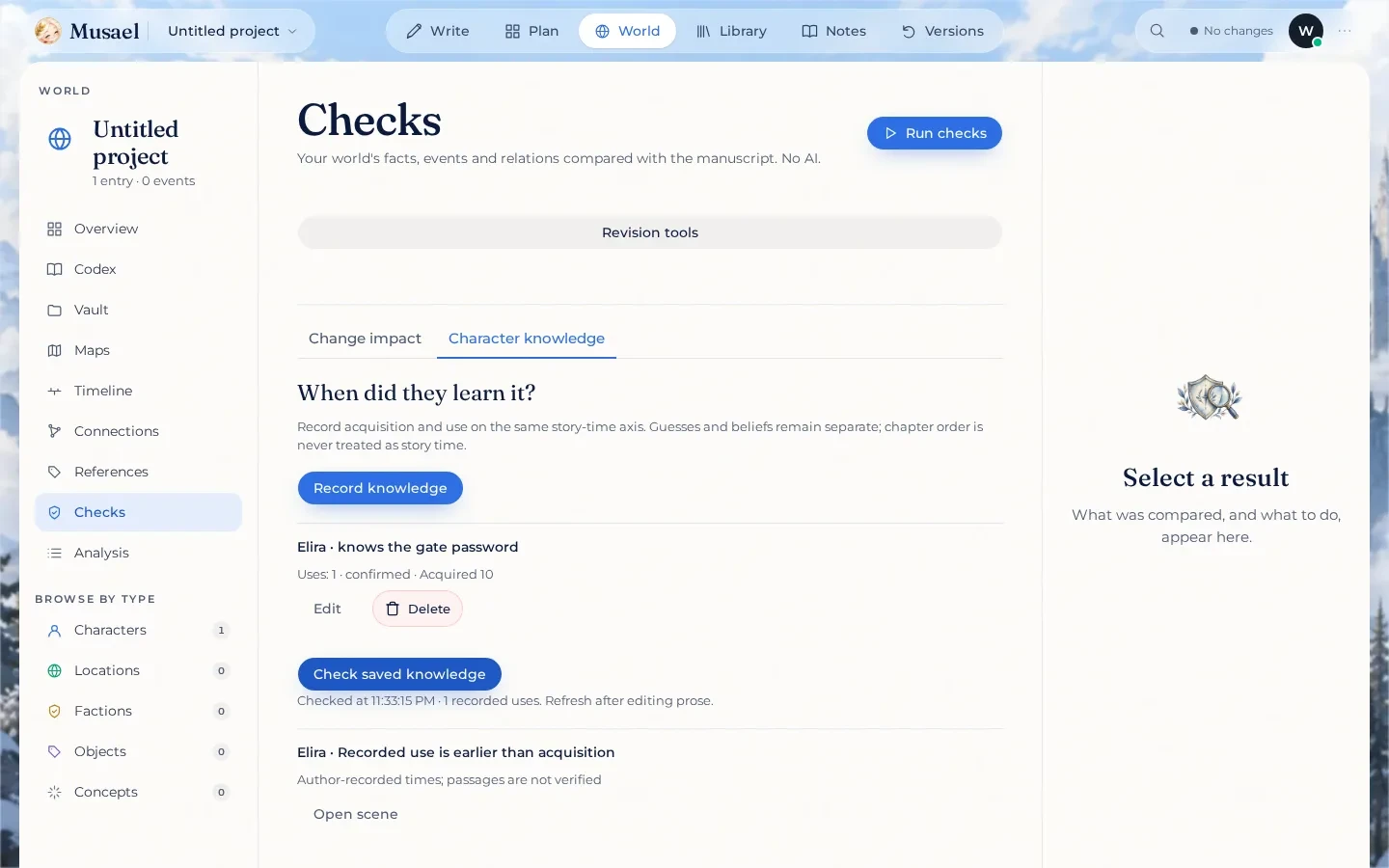
This screenshot uses a test project. The “passages are not verified” message matters: the timing record can be useful while its supporting passages still need checking. Time consistency and evidence quality are separate questions.
A scene presented in chapter eight might happen before chapter one. Keep the bible's chronological information separate from where the reader encounters the passage. Moving a chapter does not automatically change a character's acquisition time.
What to inspect when a fact changes
You decide the letter was found at the archive, not beneath the bridge. First change the relevant draft and World record deliberately. Then inspect the explicitly linked sources, character claims and scenes through change impact. Add scene tasks for the passages that need revision.
The view follows recorded references. It is not a guarantee that every unlinked mention in the book has been found. Search for the old location as an additional editorial pass, then reread the affected thread in Plan → Revision.
If the source passage has changed, refresh the check before trusting its status. A source attached last week is not necessarily evidence for today's wording. Keep a version or recoverable export before a major restructure.
A ten-minute maintenance routine
After a writing session, update only what changed:
- Add a new fact that the scene actually establishes.
- Mark a character interpretation as belief when its truth remains unknown.
- Attach the passage for any record that will constrain a later scene.
- Record a knowledge acquisition if a future reveal depends on it.
- Leave one concrete task for a contradiction you are postponing.
Once a week, read a difficult POV or subplot through the saved manuscript. That is a more useful test of the bible than counting its entries. The bible serves the book when it helps you make the next justified revision.
Footnotes
-
Keep recoverable exports of your work. A server copy does not automatically include changes that are still stored only in your browser. ↩
FAQ — Frequently Asked Questions
Do I need to plan the whole world before I start writing?
No. Start with the people, places and facts that your next scene needs. Add detail when it helps you draft or revise.
Can a story bible work for discovery writing?
Yes. Record useful details after you write a scene, then revisit them during revision.
Will a continuity checker keep the bible correct automatically?
A checker can report the rules it can evaluate. The writer still needs to review evidence, uncertainty and changes to the manuscript.