TL;DR
Third person limited stays inside one viewpoint character, so the reader knows only what that character perceives and guesses. Third person omniscient has a narrator outside the cast who knows every mind, the past and the future, and speaks in its own voice. Third person multiple is limited with several viewpoint characters, one per scene. Narrative distance (close or distant) is a separate dial from all three. Choose by asking what the reader must know that no character knows, how many inner lives the plot needs, and whether you have a narrator's voice worth 300 pages.
Third person limited stays inside one character's head at a time, so the reader knows only what that character perceives and guesses. Third person omniscient is told by a narrator who stands outside every character, knows all of them, and can tell the reader things nobody in the scene knows.
That is third person limited vs omniscient in two sentences. The trouble starts when you apply it to a manuscript, because on a single page the two can look alike. Both use he, she and they. Both can report thoughts. The difference lies in where the knowledge comes from, and you only see that across a whole scene. So this guide writes one scene both ways and marks what changed, then gives you a test for your own book.
What is the difference between third person limited and omniscient?
Start with one question: who is telling this?
In third person limited, nobody you can point to. The narration is fastened to one viewpoint character. It borrows her vocabulary and notices what she would notice. If she doesn't know a stranger's name, the page doesn't know it either. Other people's thoughts reach the reader only as her guesses, read off faces and voices. Every line passes through her, so the mode leans on how well you know that person, and time spent on character development shows up sentence by sentence.
In third person omniscient, a narrator is telling it. That narrator has its own knowledge and its own way of talking, even if it never says "I." It can report what two people in the same room are each thinking. It can tell you what happened in this town forty years ago, or what will happen next spring. It can hold opinions about the characters and share them.
"Omniscient" means all-knowing, and the word describes what the narrator has access to. It doesn't oblige the narrator to tell everything. An omniscient narrator still chooses what to reveal and when, like any storyteller.
A quick check for any page: find a sentence that states something as fact, then ask who could know it. If the answer is always the same character, you're reading limited. If the answer is sometimes "no one in the scene," you're reading omniscient.
Third person limited vs omniscient: a comparison table
Most comparisons stop at two modes. Novelists usually choose among three, because limited with several viewpoint characters behaves differently from limited with one.
| Third person limited (one viewpoint) | Third person multiple (limited, several viewpoints) | Third person omniscient | |
|---|---|---|---|
| Whose thoughts the reader gets | One character's, for the whole book | One character's per scene or chapter, several across the book | Anyone's, as the narrator chooses, plus the narrator's own commentary |
| What the narrator can reveal | Only what the viewpoint character perceives, remembers or infers | Only what the current viewpoint character knows. The reader adds it up across viewpoints | Anything: hidden motives, the past, the future, events no character witnesses |
| How switches are signalled | No switches | A scene or chapter break, then the new character named in the first line or two | A guiding sentence in the narrator's voice that walks the reader from one mind to the next |
| Typical risk | The plot needs information your character can't have, so you contrive an overheard conversation | Too many viewpoints, each too thin for the reader to care about | Distance: the reader watches everyone and feels close to no one. Handled carelessly, it reads as head hopping |
Scroll horizontally to see all columns. Arrow keys work when the table is focused.
The second row decides most books. Ask what your story needs the reader to know, then find the column that can deliver it.
The last row holds the limitations of third person omniscient. A narrator who can enter every mind tends to hover above all of them. Suspense gets harder too, because the reader may wonder why an all-knowing narrator is holding something back. And the mode asks for a voice that can carry a whole novel.
One scene in both points of view
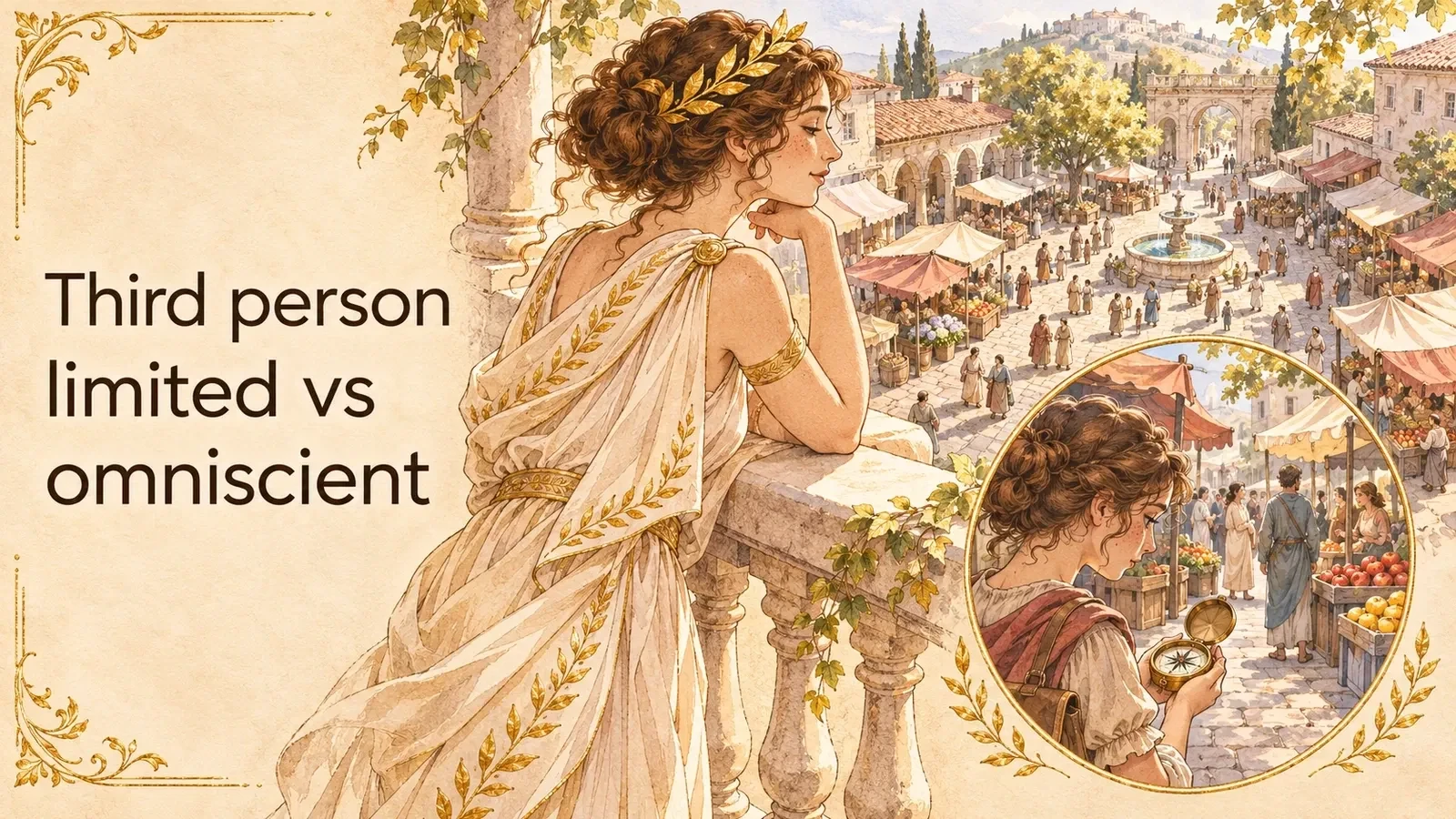
Definitions only go so far. Here is one scene: a young woman tries to buy back her mother's compass from a market dealer without letting him see how much she wants it. The events are the same in both versions.
Close third person limited
Original example, told from Ines's viewpoint:
The compass sat between a cracked teapot and a tray of buttons, and Ines made herself look at the buttons.
"How much for the tray?" she asked.
The dealer didn't glance up from his ledger. "Four."
Four was robbery. She nodded as if it weren't and let her hand drift left, slowly, the way you'd reach past a sleeping dog. The brass was colder than she remembered. Her mother's initials were still scratched under the hinge. She could feel them with her thumb.
"And this old thing?"
Now he looked up. His eyes went to her thumb, then to her face, and something in his own face settled. He had seen. Of course he had seen.
"Thirty," he said.
She had eleven coins and a ferry to pay for. "It doesn't even point north."
"Then you won't miss it." He held out his palm, pleasant as a priest.
Ines set the compass on the table. It took her fingers a moment to open. Somewhere behind her a fishwife was laughing, and Ines hated the woman with her whole chest.
Third person omniscient
Original example, told by a narrator with a voice of its own:
On the last market day before the rains, two people stood over a brass compass, and each was sure the other held the advantage.
Ines Calloway had eleven coins and a plan she considered subtle. She asked the price of a tray of buttons. Orrin Vasque, who had sold junk on Tanner's Quay for thirty years and had watched a great many people pretend to want buttons, said four, and waited.
Her hand drifted to the compass. Her thumb found the initials under the hinge, and Orrin, seeing it, raised a price of six to thirty. He took no pleasure in it. His rent was due on the first, and a grieving girl was, in his long experience, a customer who found the money.
"It doesn't even point north," Ines said, which was true, and which would matter a great deal to her in a month's time, on a different coast.
"Then you won't miss it," said Orrin.
She set it down. Neither of them noticed the boy by the fish stall, who had been watching that compass a good deal longer than they had.
What changed
The opening. The limited version begins inside Ines's attention: she "made herself look at the buttons," and we know why before anyone speaks. The omniscient version begins above the stall. The narrator places the day in the calendar and passes judgment on both people at once: each "was sure the other held the advantage."
The dealer. In limited he has no name, because Ines doesn't know it. His mind is closed. "Something in his own face settled" is what she sees, and "Of course he had seen" is her inference, which could be wrong. In omniscient he is Orrin Vasque, with thirty years on the quay and rent due, and the reader is told flatly that he takes no pleasure in the price.
Knowledge nobody in the scene has. The omniscient narrator knows the broken compass will matter "in a month's time, on a different coast," and knows about the boy by the fish stall. Limited can do neither. Ines can't see the future, and she has her back to the boy.
Whose voice makes the comparisons. "The way you'd reach past a sleeping dog" and "pleasant as a priest" belong to Ines. "A plan she considered subtle" belongs to the narrator, who is gently amused by her. That amusement is the narrator's voice, the thing omniscient has and limited doesn't.
What each version paid. Omniscient lost the cold brass under her thumb and the flash of hatred for a laughing stranger. You watch Ines more than you feel her. In return you can sympathize with both sides of the stall, and the question shifts from "will she get it back?" to "what is this compass going to do?" Limited keeps you in her skin and makes Orrin an obstacle. Same events, two different scenes.
Third person multiple: limited with several viewpoint characters
Suppose you want Orrin's rent and the cold brass under Ines's thumb. You don't need omniscient for that. Third person multiple gives each character scenes of their own: the market from Ines's side, a scene break, then Orrin counting the day's take and thinking about the girl with the compass. Each scene obeys the limited rules. The reader gets both minds, never in the same paragraph.
You'll recognize the pattern from romances that alternate between the two leads and from epic fantasies that rotate through a cast chapter by chapter.
Compared with omniscient, you give up the narrator. Nobody can tell the reader about next month on a different coast, and the boy by the fish stall stays invisible unless he gets a scene too. You gain closeness every time the viewpoint changes. You also gain a clean kind of irony: the reader, holding two partial accounts, understands more than either character.
The cost is spread. Every added viewpoint takes pages from the others, so each one should earn its place. A character earns a viewpoint when they witness events no other viewpoint character can, or when their reading of a shared event changes what the reader understands. If you're weighing a cast of four or five, the guide to planning a multiple-POV novel walks through who gets scenes and in what order.
Narrative distance: close and distant third
This is where most of the confusion comes from. Limited and omniscient describe what the narration knows. Narrative distance describes how near the narration sits to a character's mind at a given moment. They are separate dials, and people mix them up because distant limited can sound like omniscient.
Here is one moment at three distances. Original example, all three in third person limited:
- Distant: On a wet market morning, a young woman named Ines Calloway stopped at a junk stall. She was anxious about money.
- Middle: Ines stopped at the junk stall. She had eleven coins, and she worried they wouldn't be enough.
- Close: Eleven coins. Eleven, and the ferry still to pay. Don't look at the compass.
The distant line sounds like a narrator introducing someone, but it contains nothing Ines doesn't know, so it is still limited. It summarizes, and it names her feeling from outside. The close line drops "she worried" altogether and gives you her thoughts in her own broken rhythm. When writers say "deep third," they mean this closest setting held for most of the book.
Most novels move the dial as they go. You pull back to cross a week of travel in a paragraph, then move in for the argument at the end of it. Omniscient has the same dial: the narrator can sink into one character for half a page, close enough to feel her pulse, then rise back out.
So when you're unsure which mode a passage is in, ignore how close it feels. Ask the earlier question: does it state anything the viewpoint character couldn't know? And if a reader says they couldn't connect with your protagonist, check distance before you change mode. Moving closer inside limited often fixes it.
Omniscient POV vs head hopping
Omniscient POV moves between minds on purpose. One narrator, established from the first page, carries the reader from Ines to Orrin with a guiding phrase ("Orrin, seeing it, raised a price of six to thirty"), and the voice stays the same on both sides of the move. Head hopping happens when a scene that has been limited to one character suddenly reports someone else's private thoughts, with no narrator in place and no signal, then snaps back. The reader loses track of whose experience they're in. On the page, the difference is the narrator: if the book has had one all along, a shift between minds reads as that narrator's choice, and if it hasn't, the shift reads as a slip. The head hopping guide shows how to find those slips in a draft and repair them.
Which point of view should your novel use?
Answer these six questions about the manuscript you're working on.
- Does the reader need to know something no character knows? A buried history, say, or the meaning of an object nobody in the cast understands. If the story depends on it and it can't wait for a character to find out, that points to omniscient. If a character can learn it in time, limited will hold.
- How many inner lives does the plot depend on? One: single limited. A handful, each with their own stake: multiple limited. A whole town or a family across generations, where the group is the protagonist: omniscient.
- Where does your tension come from? If it comes from the reader not knowing (who is lying, what is behind the door), limited keeps the secret honestly, because the viewpoint character doesn't know either. If it comes from the reader knowing more than the characters, watching two people misread each other, choose multiple or omniscient.
- Do you have a narrator's voice? Write one paragraph in which a narrator comments on your protagonist, wry or tender, your pick. If the voice arrives easily and you'd like to hear it for 300 pages, omniscient is open to you. If it sounds like you clearing your throat, stay in limited.
- How much depends on the reader feeling what one person feels? Romance and horror usually live in the body: a held breath, a hand that is slow to open. Close limited delivers that most directly.
- What does your draft already do? Take a finished scene and write initials in the margin beside every stated thought or fact, marking who could know it. One set of initials means you're writing limited already. Several sets means you have a decision to make: commit to a narrator, or cut the drift.
If your answers split, do what this article did and write one scene both ways. The version you want to keep writing is your answer.
Whichever mode you choose, it only holds if every scene obeys it. For limited and multiple, that means one named viewpoint character per scene, decided before you revise. In Musael, the Plan keeps the point of view on each scene next to its status and notes, and a filter shows one character's thread, so you can read Orrin's scenes in a row and check that nothing in them knows more than he does.
FAQ — Frequently Asked Questions
Is Harry Potter third person limited or omniscient?
The Harry Potter novels are told mostly in third person limited from Harry's viewpoint. A few chapters leave him, for example the opening chapter of Harry Potter and the Half-Blood Prince, which is set with the Muggle Prime Minister. So the short answer is limited, with a few exceptions.
What is third person objective, and how is it different from omniscient?
Third person objective reports only what a camera and a microphone could record: actions and speech. No character's thoughts are given. Omniscient has access to every mind and objective has access to none, so they sit at opposite ends of the third-person range.
Can you mix third person limited and omniscient in the same novel?
Yes, if the pattern is set early and repeated. One workable arrangement opens each chapter in an omniscient narrator's voice, then settles into a single character's limited viewpoint for the scene. What readers resist is a narrator who appears once on page 200 with no precedent.
Can a third person limited narrator describe what the viewpoint character looks like?
Yes, but only through details the character would be aware of in that moment: a sleeve that's too short, or the way a stranger looks at her scar. A full inventory in front of a mirror breaks the illusion, because people don't think about their own faces that way. Other characters' reactions and remarks can carry the rest.
How is third person limited different from first person?
Both confine the reader to one mind's knowledge. In first person the character is the narrator, speaks as "I," and may be telling the story afterward with hindsight. Third person limited uses he, she or they, and it lets you vary the distance or hand the next scene to a different viewpoint character without changing the book's grammar.