

At a glance
| Capability | Musael | Obsidian |
|---|---|---|
| Draft a manuscriptGeneral notes or documents can hold prose; this is not the same built-in scene workflow. | Yes | Partial |
| Scene planning or document organizationMusael Plan and manuscript share scene records. General document/note organization is a different workflow. | Yes | Partial |
| Read saved scenes by POV or plotlineMusael Plan Revision uses explicit assignments. An equivalent competitor workflow was not established by the sources checked. | Yes | Unknown |
| Explicit fact, belief and source recordsMusael distinguishes recorded epistemic kind and passage evidence; a general story bible is not automatically the same data model. | Yes | Unknown |
| Check recorded knowledge timingAuthor-recorded acquisition and uses are compared in story time. No universal inference from prose; unknown dates stay uncertain. | Yes | Unknown |
| Live project collaborationEquivalent live editing was not verified; file sync and exporting are not treated as co-writing. | Yes | Unknown |
| Export for a recoverable manuscript handoffVerify the file format and round trip; comments, settings and proprietary records do not necessarily transfer. | Yes | Yes |
Scroll horizontally to see all columns. Unknown means the available source does not establish the feature.
A local knowledge vault or a connected manuscript?
Choose Musael when your main job is finishing a coherent novel with scenes, plotlines, World evidence and readers connected. Choose Obsidian when local Markdown notes, research links and a customizable knowledge vault are the center of your work. Its local files and open formats are meaningful advantages, particularly for writers who want to maintain their own archive.
We build Musael. Obsidian's official site was checked on 3 October 2026. We did not benchmark a customized vault or any community novel-writing plugin.
Linked notes are valuable research
Obsidian stores notes locally as Markdown, supports links and a canvas, and offers plugins to adapt the workflow. A writer can keep historical research, character notes and scene fragments in the same vault. Those files can remain useful independently of a particular editing tool.
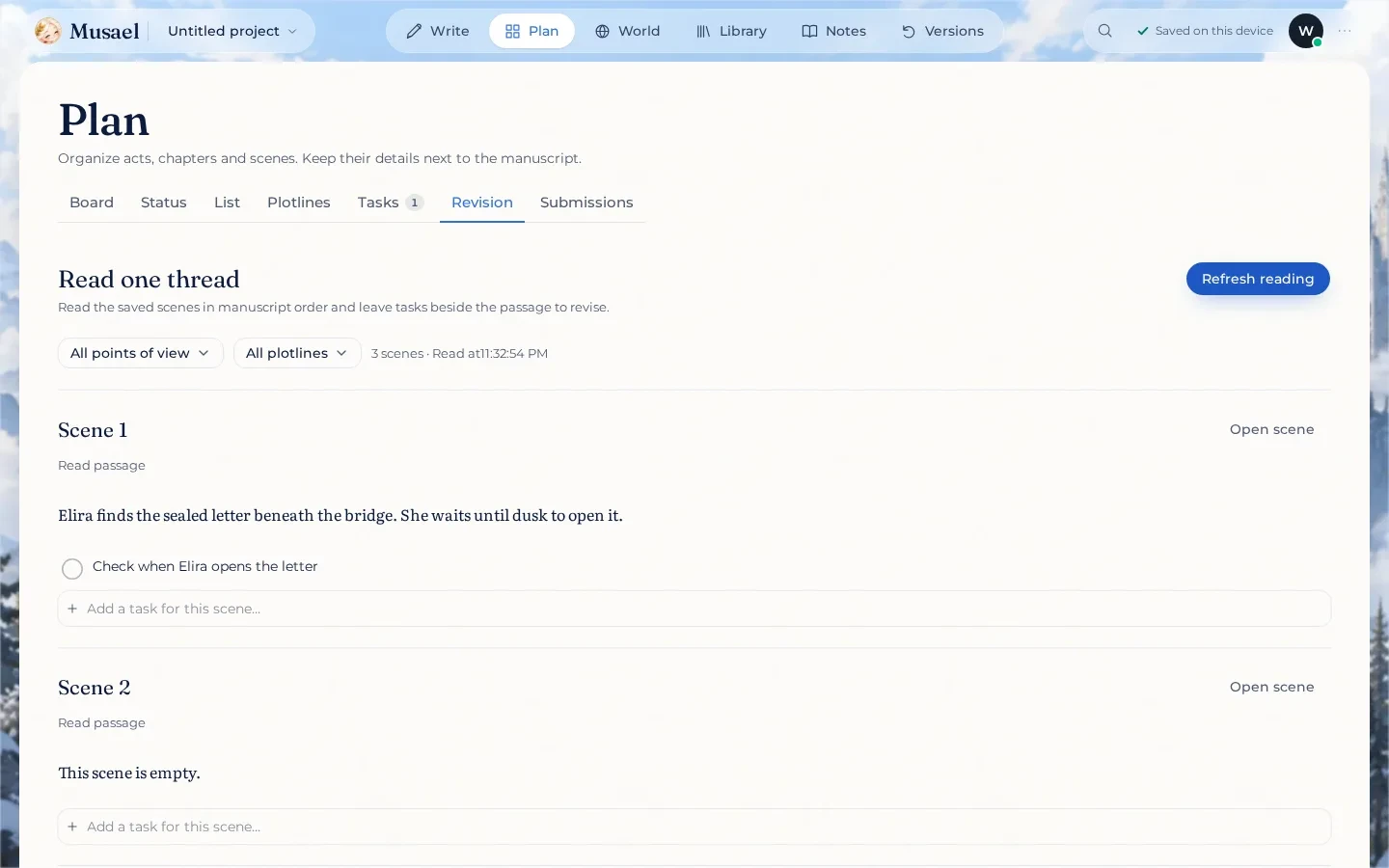
Actual Musael Plan Revision in a test project: saved passage and persistent task. This image is not a competitor benchmark.
The difficult question is which file is the authoritative manuscript and how its order is maintained. A novel built from notes can work well, but export, scene metadata and plugin behavior need a clear convention. Several possible systems are not the same thing as a built-in workflow.
Musael uses scene records shared by Plan and the manuscript. Assign a POV and plotline, then read the thread's saved prose in Plan → Revision. Tasks stay beside the scene that needs editing. There is one authoritative scene document rather than an extracted copy of the chapter to maintain.
A link does not prove a fact
A backlink to a character note can indicate a mention. It does not by itself tell you whether the passage states a fact, repeats a rumor or contradicts an earlier scene.
Musael's World separates confirmed facts from beliefs and hypotheses and connects evidence passages to the records. Explicit change impact follows recorded references to dependents. Author-recorded knowledge acquisition and uses can be checked in story time, while uncertain dates and stale evidence remain visible.
This does not establish automatic interpretation of every sentence. Obsidian plugins could implement related workflows, but each plugin requires its own verification. We do not mark the entire plugin ecosystem absent or assume that a native graph view is equivalent to a continuity engine.
Offline work, sync and sharing
Obsidian's official site describes local files, optional Sync and Publish. Local use, synchronization and public note publishing are different services with different conditions. Include any paid service or plugin dependency in the comparison.
Musael keeps durable local writing in the browser and supports account sync, project collaboration and separate reader links. Prepare offline availability before travelling and keep recoverable exports. Local persistence and a remote backup are different guarantees in both workflows.
Compare the Obsidian setup you actually need with Musael pricing. Keep Obsidian if its research vault and configurable tools are the main value. We recommend Musael when the cost of maintaining manuscript order, revision tasks and story evidence outweighs the value of building the system yourself.
Import only what you can verify
Keep the vault intact. Use Musael's Markdown-folder import on a small selected folder and inspect the preview. Check scene order, links, formatting and any missing files before accepting the import.
Plugin settings, canvas layouts, frontmatter semantics and embeds are not guaranteed to reconstruct as Musael records. Separate research you want to retain in Obsidian from prose you want to revise in Musael. An intentional split can be better than trying to turn every note into a chapter.
FAQ
Does Obsidian work offline?
Yes. Its official site describes local notes accessible offline. Optional synchronization and publishing have separate conditions.
Are backlinks the same as continuity checks?
No. Backlinks show note relationships; a check needs explicit meaning, time and evidence. A specialized plugin may add behavior, but that requires a separate assessment.
Can I keep research in Obsidian while writing in Musael?
Yes. Decide where the authoritative manuscript and confirmed story records live. Avoid two independently edited copies of the same draft.
Sources and verification
Obsidian's official site and Musael product, checked on 3 October 2026. Community plugins and complex-vault migrations were not tested.