

At a glance
| Capability | Musael | Fictionary |
|---|---|---|
| Draft a manuscriptOfficial descriptions establish writing; edition and platform conditions still apply. | Yes | Yes |
| Scene planning or document organizationMusael Plan and manuscript share scene records. General document/note organization is a different workflow. | Yes | Yes |
| Read saved scenes by POV or plotlineMusael Plan Revision uses explicit assignments. An equivalent competitor workflow was not established by the sources checked. | Yes | Unknown |
| Explicit fact, belief and source recordsMusael distinguishes recorded epistemic kind and passage evidence; a general story bible is not automatically the same data model. | Yes | Unknown |
| Check recorded knowledge timingAuthor-recorded acquisition and uses are compared in story time. No universal inference from prose; unknown dates stay uncertain. | Yes | Unknown |
| Live project collaborationEquivalent live editing was not verified; file sync and exporting are not treated as co-writing. | Yes | Unknown |
| Export for a recoverable manuscript handoffVerify the file format and round trip; comments, settings and proprietary records do not necessarily transfer. | Yes | Unknown |
Scroll horizontally to see all columns. Unknown means the available source does not establish the feature.
Structural coaching or connected manuscript evidence?
Choose Musael when the manuscript, World records, subplot revision and readers need to stay connected. Choose Fictionary if its scene-level structural framework, visual review and guided writing feedback are the main tools you want to use. Fictionary's current product description spans outlining, writing and revision; it should not be reduced to a single editing report.
We build Musael. Fictionary's official site was checked on 3 October 2026. The comparison uses advertised capabilities, not a paid-account assessment of its AI instructor.
Ask a specific structural question
Fictionary describes working from an imported manuscript or an outline, reviewing story elements and getting scene-specific feedback from Edwina, its AI writing instructor. That is relevant for a writer who wants a guided framework for understanding a draft's middle, character arc or scene purpose.
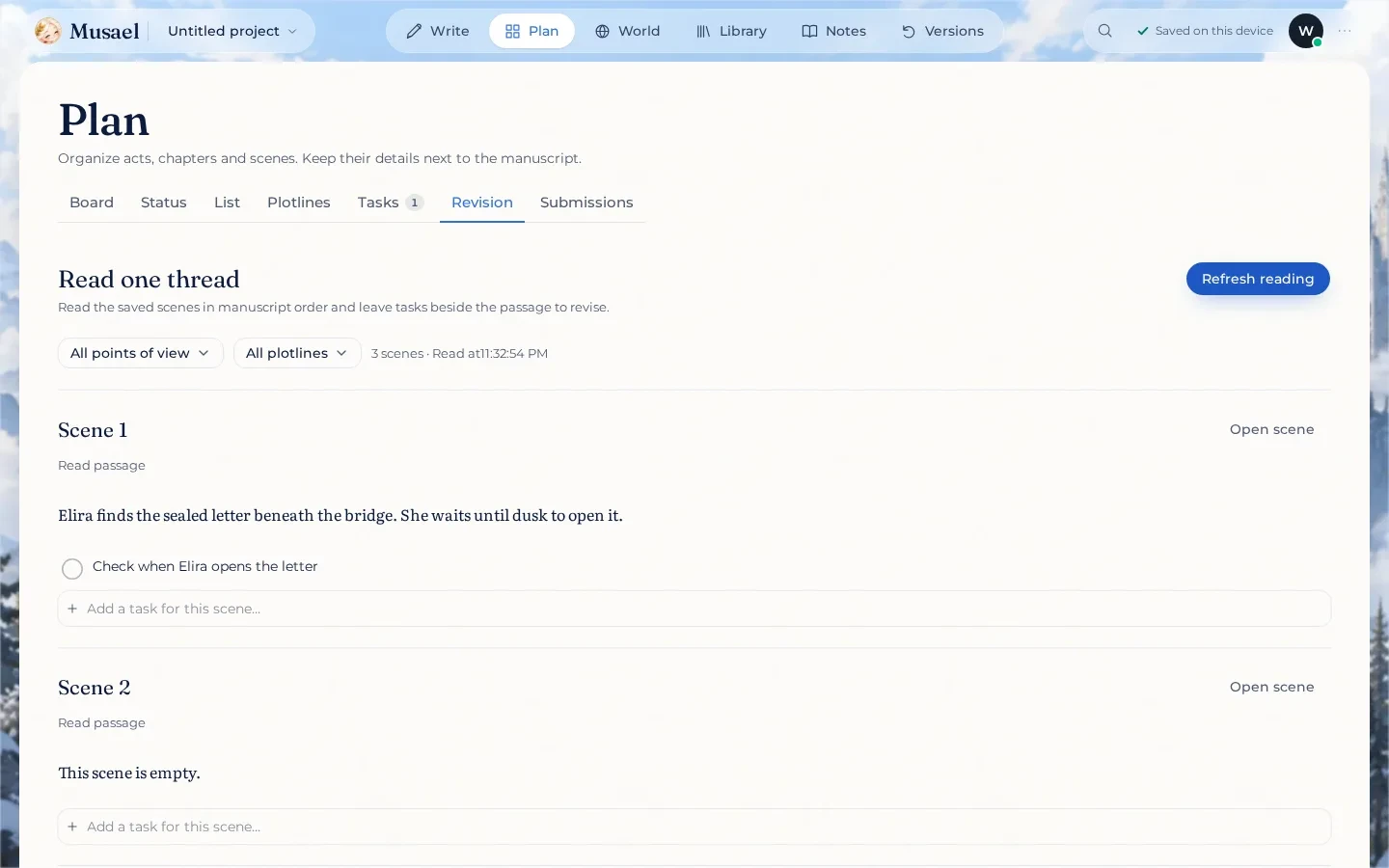
Actual Musael Plan Revision in a test project: saved passage and persistent task. This image is not a competitor benchmark.
Musael's Plan connects the outline and scene records to the actual manuscript. POV and plotline filters in Plan → Revision collect saved passages with the thread notes, and persistent scene tasks record what the writer wants to change.
Consider a midpoint that changes the plan but not the protagonist's behavior. Read the scenes immediately before and after it through that POV. Does the character take a new risk, abandon an old tactic or merely hear new information? A label such as “midpoint” does not answer the editorial question. The passages and subsequent choices do.
Structure and continuity need different evidence
An uneven character arc and an impossible knowledge sequence are different problems. Musael's World separates confirmed facts, beliefs and hypotheses. Sources attach records to passages; change impact follows explicit dependents and scenes.
For a secret, record acquisition and uses in story time. The knowledge check can flag a recorded early use, while missing or overlapping dates stay uncertain. Changed or absent evidence is shown separately. It does not automatically determine the emotional strength of a scene or infer every story fact from text.
Fictionary advertises scene-specific structural feedback. Its checked homepage does not establish the same deterministic evidence-and-time model, so that narrow competitor capability remains unknown. Nor does the existence of AI feedback prove a literary-quality advantage for either product.
Cost, feedback and control
Fictionary advertises membership and a trial for StoryTeller Premium. Check the current tier, renewal terms, trial conditions and included feedback before purchase. An advertised membership should not be compared with an unrelated discounted or coaching package.
Musael's subscription and usage terms are on pricing. Managed AI has separate request preparation, consent to send and approval of edits. Deterministic revision reading and World checks do not need a model request; co-author editing and reader links are separate sharing choices.
We recommend Musael when structural revision must remain connected to the world and authoritative manuscript. Fictionary may fit better when its guided framework is the specific coaching process you want to follow.
Start with a representative sequence
Keep your original project and a manuscript export. Bring supported prose into Musael through the import preview, then check scene divisions, order and formatting. Structural scores, annotations, AI conversations and proprietary project records are not guaranteed to transfer with text.
Choose three scenes around a turning point rather than a polished opening. Try POV reading, add one revision task and check a relevant World fact. That exercise reveals whether the connected workflow helps the revision you are actually doing.
FAQ
Is Fictionary only an editing tool?
Its current site presents outlining, writing and revision, including scene-specific AI feedback. This comparison acknowledges that wider workflow.
Does Musael score the quality of a character arc?
No. It supports scene reading, notes and explicit checks. The writer must judge whether the choices and consequences make the arc convincing.
Which should I try for a tangled multi-POV draft?
We recommend Musael when you want thread reading and World evidence together. Try Fictionary if a guided structural framework is your priority. Test a difficult sequence rather than judging a prepared demo.
Sources and verification
Fictionary's official site and Musael product, checked on 3 October 2026. No paid-account, AI-quality or coaching assessment was performed.