

At a glance
| Capability | Musael | Campfire |
|---|---|---|
| Draft a manuscriptOfficial descriptions establish writing; edition and platform conditions still apply. | Yes | Yes |
| Scene planning or document organizationMusael Plan and manuscript share scene records. General document/note organization is a different workflow. | Yes | Yes |
| Read saved scenes by POV or plotlineMusael Plan Revision uses explicit assignments. An equivalent competitor workflow was not established by the sources checked. | Yes | Unknown |
| Explicit fact, belief and source recordsMusael distinguishes recorded epistemic kind and passage evidence; a general story bible is not automatically the same data model. | Yes | Unknown |
| Check recorded knowledge timingAuthor-recorded acquisition and uses are compared in story time. No universal inference from prose; unknown dates stay uncertain. | Yes | Unknown |
| Live project collaborationAdvertised collaboration; verify the required tier and scope. Reader feedback and public publishing are separate. | Yes | Yes |
| Export for a recoverable manuscript handoffVerify the file format and round trip; comments, settings and proprietary records do not necessarily transfer. | Yes | Unknown |
Scroll horizontally to see all columns. Unknown means the available source does not establish the feature.
Which one should you choose?
Choose Musael when the book is the center of your work and you want its scenes, World evidence and reader feedback connected. Choose Campfire when you want to assemble a modular worldbuilding toolkit or publish through Campfire's book ecosystem. Both cover more than a blank writing page, but their organizing principles and purchasing models differ.
We make Musael. This comparison uses Campfire's official product and publishing descriptions, checked on 3 October 2026. It does not claim that we tested every module or bought a competitor subscription. A capability marked Unknown is outside the available evidence, not necessarily absent from the product.
Modules and worldbuilding
Campfire describes eighteen worldbuilding modules with limited free access and paid options for additional use. Character creation, story planning and related worldbuilding tools can be chosen as parts of that toolkit. The modular model can make sense when your world contains material for several books, games or other media rather than only a manuscript.
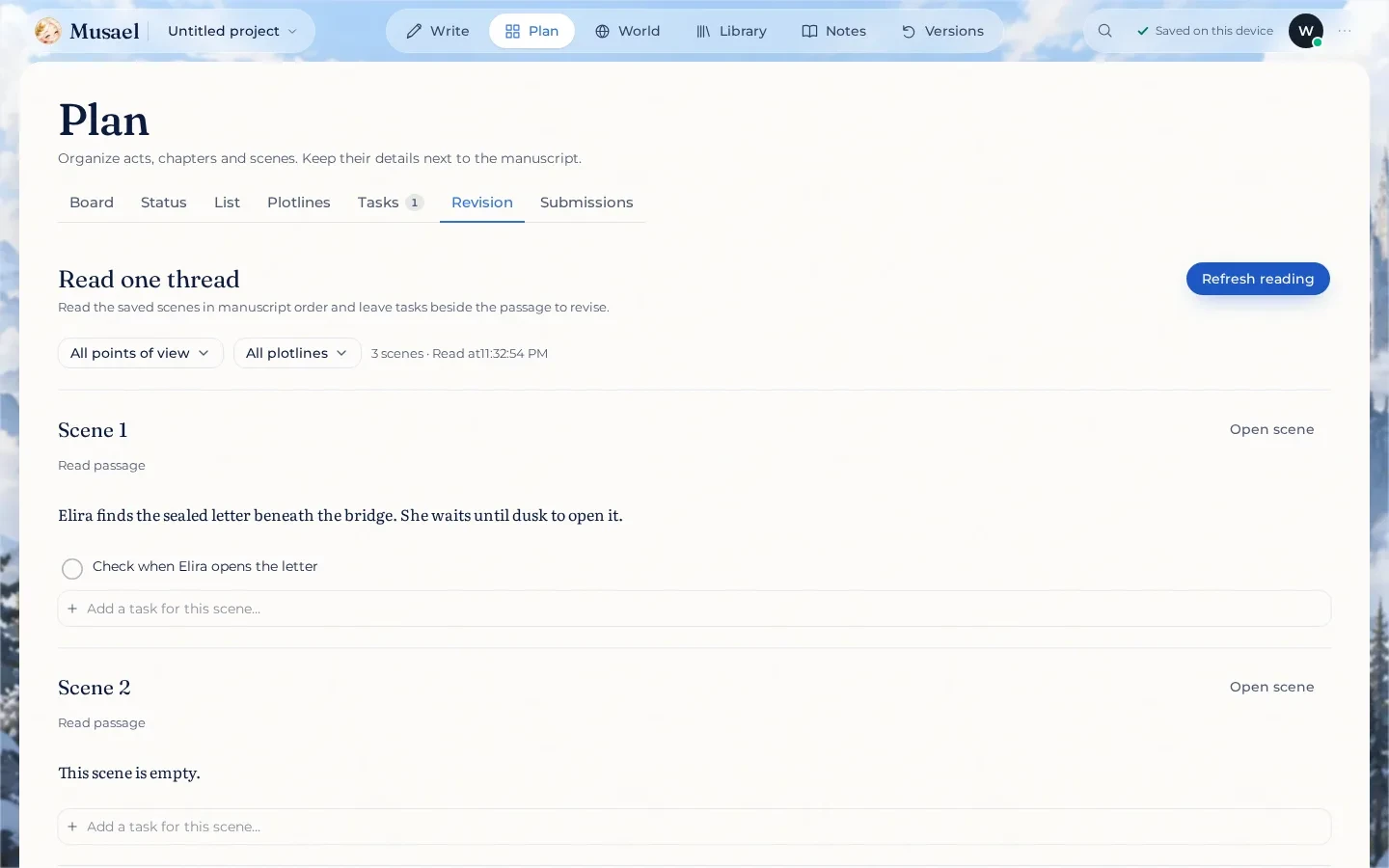
Actual Musael Plan Revision in a test project: saved passage and persistent task. This image is not a competitor benchmark.
Musael's World supports linked entries, typed fields, relationships, events, maps and source annotations alongside the book. A confirmed world fact is distinct from what a character believes or what the author is still considering. You can change an entry's structure without turning every part of the project into an untyped note.
Suppose the northern gate opens only after a treaty is signed. Store the relevant event, the rule and the passage that establishes it. Then distinguish Elira's belief about the gate from the confirmed rule. That distinction is why we recommend Musael for a book where world information must remain coherent across scenes. It is not a claim that worldbuilding depth can be measured by the number of modules alone.
Drafting and checking a change
Musael's manuscript and Plan use the same scenes. The plotline grid records what each subplot does in those scenes, and Revision reads the saved passages by POV or thread. Tasks remain attached to the scenes where you intend to revise the writing.
The change-impact tool follows explicit references through World records. After changing the treaty date, you can inspect records that depend on the event and open linked source scenes. It does not search every sentence and declare all unlinked references corrected. Unknown time and a missing source produce an unresolved result rather than invented certainty.
Campfire's worldbuilding and planning modules are useful for assembling and reviewing lore. The source examined here does not establish an equivalent author-recorded knowledge-time check with verified manuscript anchors. That row remains Unknown. A visual planning feature or a general AI response is not automatically the same kind of check.
Readers and public publishing
Campfire also has a publishing dashboard and bookstore. Its official description says an author can bring an EPUB to the publishing system without using the writing software. That is a separate route to distribution, not simply a setting on a story-bible module.
Musael has live project collaboration, private reading links with feedback and public story pages. A story page does not imply a bookstore, payment collection for fiction or the same discovery network as Campfire. If selling in that ecosystem is your goal, evaluate Campfire's current publishing terms directly.
If your immediate problem is beta feedback while the manuscript is still changing, Musael's connected project is our recommendation. Select the reading scope, give a reader the link and return their observations to the scenes that need work. Public publishing can remain a later choice; you do not have to expose the working world to get useful feedback.
Cost, export and a sensible trial
Campfire advertises limited free module use, paid options and lifetime purchases. Its lowest module price is not the cost of every module you might need. List the modules and limits relevant to your project, then compare the actual configuration with the Musael plan on pricing. Avoid comparing a partial module purchase with an entire workspace subscription as though they were equivalent packages.
Musael exports Word, EPUB and HTML and provides book-design/reading presets with browser printing. It also produces portable project backups. An output document and a full project archive serve different purposes: the former is for readers or publishing; the latter preserves more of your working structure.
A native, complete Campfire-project migration is not promised. For a trial, export supported prose and copy the essential lore through Word or Markdown into a new Musael project. Check the scene order, attachments and World links. Keep the original Campfire project until a representative part of the book works in the new arrangement. Rebuilding an elaborate modular world can be a meaningful switching cost.
FAQ
Is Campfire only for worldbuilding?
No. Its official site includes writing/planning modules and a publishing system. This comparison separates building the project from distributing an EPUB through the bookstore rather than treating them as one feature.
Can I buy only the Campfire modules I need?
Campfire describes modular access and paid options, including lifetime purchases. Check the current configuration and limits on its official pricing pages. The smallest advertised price does not necessarily cover a complete writing setup.
Why would I choose Musael for a fantasy series?
Choose it when the recurring work is tracing world information into the manuscript, reading POV/subplot sequences and handling reader feedback in the same project. Campfire may suit you better when its particular worldbuilding modules or publishing ecosystem are the decisive requirement.
Sources and verification
Campfire's official site was checked on 3 October 2026. This is a workflow comparison, not a paid-account benchmark, and it makes no claim about either product's effect on book sales or literary quality.
